
Disclaimer: The information provided on bunnyowners.com is for educational purposes only and does not constitute veterinary medical advice; always consult your vet before changing your rabbit’s diet. Additionally, this post contains affiliate links. As an Amazon Associate, and other affiliate advertising programs, I earn from qualifying purchases at no extra cost to you
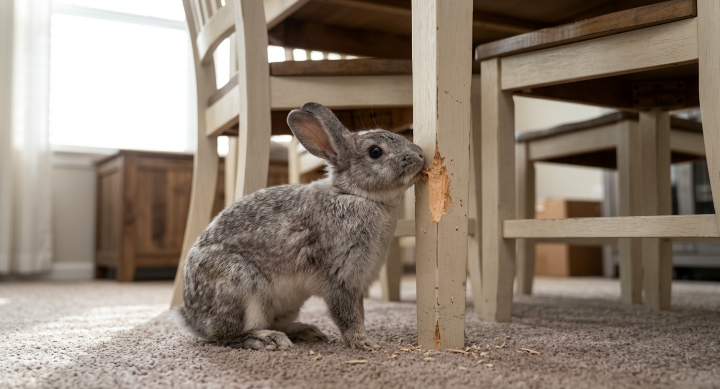
If you’ve walked into your living room only to find severed charging cables, stripped baseboards, or a freshly disemboweled couch cushion, your immediate reaction is likely a mix of panic and frustration. When your home is being chewed and dug up piece by piece, it is completely normal to wonder why your pet is acting so destructive and whether understanding rabbit behavior can help reveal if they are acting out of anger, boredom, or spite.
Rabbits destroy household items because chewing, digging, shredding, and foraging are natural survival instincts essential for wearing down continuously growing teeth and exploring their territory. Rather than acting out of bad behavior or spite, house rabbits simply direct these powerful biological drives toward modern furnishings that mimic natural outdoor textures like roots, soil, and bark. Owners can successfully stop household damage by rabbit-proofing high-risk areas and redirecting these natural behaviors toward safe chew toys, dig boxes, and daily foraging activities.
Understanding that your rabbit’s destructiveness is an instinctual drive rather than a bad habit changes everything about how you manage your home. Once you stop trying to eliminate these natural instincts and instead redirect them, protecting your home becomes much easier. In this guide, we will break down the exact biological instincts driving your rabbit’s actions, help you decode what their rabbit body language is trying to tell you, and provide practical, step-by-step solutions to better understand overall rabbit behavior and restore peace to your home.
1. Is It Normal for Rabbits to Destroy Things?
Yes, it is entirely normal. In fact, a rabbit that never chews, digs, or investigates their environment is far more unusual—and often a sign of illness or depression—than one who treats your living room like a construction site.
Getting a feel for what drives your pet every day begins with understanding core rabbit behavior and how their natural instincts shape their world. Once you start picking up on subtle body language, it becomes much easier to tell whether your bunny is simply being curious, bursting with energy, or trying to vent a little frustration.
The Indoor Instinct Gap
To understand why your rabbit seems intent on remodeling your house, it helps to see how indoor items share similar textures and properties with natural elements in the wild. The following table maps natural outdoor materials to the indoor items your rabbit targets every day:
Outdoor vs. Indoor Material Comparisons
| Wild Environment | Indoor Equivalent | Why Rabbits Interact With It |
|---|---|---|
| Soil & Dirt | Carpet & Rugs | Feels diggable and offers resistance under paws |
| Bark & Plant Casing | Cardboard & Paper | Soft, crisp materials that are easy to chew and tear |
| Roots & Branches | Furniture Legs & Baseboards | Rigid, firm surfaces that provide resistance to jaws |
| Dry Grasses & Foliage | Blankets & Upholstery | Soft, pliable textures ideal for gathering or moving |
Wild rabbits spend much of their active time digging burrows, chewing vegetation, and modifying their environment, as noted by the RSPCA. Bringing a rabbit indoors doesn’t erase thousands of years of evolution. To your pet’s instinctual brain, carpet feels like packed dirt waiting to be cleared, a table leg provides the satisfying density of a root, and cardboard satisfies the urge to strip soft bark.
Why Indoor Rabbits Seem More Destructive
Indoor spaces simply make this behavior more concentrated. Limited room condenses natural energy onto specific target areas, and soft modern materials offer extremely satisfying feedback to sharp teeth and paws. Understanding that this is an environmental mismatch—rather than a behavioral flaw—is the key to finding peace in your home.
In my own home with my Lionhead rabbits, Mocha and Chino, I’ve watched this exact dynamic play out firsthand. Whenever Chino decides to dig frantically at the corner of a hallway rug, he isn’t being stubborn or naughty—he’s following the exact same biological impulse that tells wild rabbits to excavate safety tunnels. Once I replaced that rug corner with a dedicated digging station, Chino quickly lost interest in the carpet and began using the new area instead.
2. What Do Rabbits Usually Destroy?
When rabbits have free-roam access, they naturally gravitate toward specific household objects that satisfy immediate tactile needs. To help you identify safe alternatives for every room, the table below breaks down the most commonly destroyed household items alongside the specific replacement that satisfies that same urge.
Commonly Destroyed Household Items and Safe Alternatives
| Item Destroyed | Why Rabbits Love It | Best Replacement |
|---|---|---|
| Electrical Cords | Resemble thin tree roots blocking tunnel paths | Cord hider tubing or elevated wiring |
| Baseboards & Walls | Eye-level wooden resistance along territorial boundaries | Plastic corner guards or apple wood sticks |
| Carpet Corners | Mimics firm, packed soil ideal for burrow entrances | Heavy ceramic tiles or a dedicated dig box |
| Furniture Legs | Heavy, stable wood surfaces that don’t slide away | Heavy unvarnished branches or twine wraps |
| Couches & Cushions | Bunch up like soft underground nesting chambers | Fleece blankets or cardboard hidey houses |
| Houseplants & Paper | Offer crisp textures for foraging and shredding | Untreated cardboard boxes or fresh herbs |
- Electrical Cords: Wires sit right at ground level and feel like thin vines or roots obstructing a burrow trail. Because rabbits slice through roots to clear pathways in nature, a cable often gets severed in a single bite.
- Baseboards and Drywall: Baseboards outline the perimeter of a rabbit’s territory. Biting them provides firm, rigid feedback to front incisors while marking boundary lines.
- Carpet Corners and Rugs: Carpet fibers yield to paws in a way that feels remarkably like loose soil, making room corners prime targets for ancestral tunneling instincts.
- Furniture Legs: Table and chair legs are anchored and heavy, giving rabbits the solid resistance they need without sliding across the floor like smaller plastic toys.
- Couches, Blankets, and Pillows: Upholstery provides soft, pliable resistance for pawing, biting, and shredding, which mimics gathering grass or clearing nesting chambers.
3. Why Rabbits Become Destructive

When a rabbit goes on a destructive spree, several biological and environmental factors are usually working together.
Continuous Tooth Growth
Because rabbit teeth grow continuously, constant chewing is a physical necessity to keep them ground down. In the wild, hours of daily nibbling on coarse grasses and bark keep everything worn down to a safe length. If teeth aren’t kept in check with plenty of fibrous material, they can quickly overgrow and form razor-sharp spurs that slice into the cheeks and tongue—a painful condition known as rabbit dental disease.
Figuring out why your rabbit chews everything begins with realizing they don’t distinguish between “acceptable” toys and off-limits furniture. To your pet, a mahogany table leg and a fresh apple branch satisfy the exact same biological drive. Supplying plenty of coarse forage is essential for keeping their teeth worn down safely, a core healthcare recommendation outlined by VCA Animal Hospitals.
If your rabbit stops eating after swallowing foreign materials, they require immediate attention.This sudden lack of appetite puts them at immediate risk of gastrointestinal stasis, which can quickly become fatal. Recognizing the early signs of GI stasis allows you to intervene before digestive slowdown becomes severe.
Warning: Synthetic items like rubber cables, carpet fibers, and painted lumber pose grave health risks. If ingested, synthetic fibers cannot be digested and can lead to life-threatening blockages.
Natural Burrowing Instincts
Carpet is one of the most common indoor digging targets because it feels surprisingly similar to packed soil. Decoding your pet’s natural digging behavior helps explain why they target specific spots. Many rabbits attack blankets, couch cushions, and litter boxes because these materials bunch up under their paws, mimicking the resistance they would encounter while excavating an underground burrow.
If your pet spends too much time confined, you might also notice them digging in their cage out of sheer boredom or frustration. Corners are particularly targeted because, in a natural setting, a dead end or corner represents the ideal location to anchor a new tunnel entrance.
Nesting and Shredding Drives
It helps to separate shredding from chewing. Chewing involves biting down to break off chunks, while shredding is an act of gripping and tearing. Cardboard boxes, paper bags, old towels, and junk mail all satisfy the same instinct to tear and manipulate materials.
Hormones often magnify this drive. Intact females frequently experience strong surges that prompt them to tear soft materials to build nest chambers, even during false pregnancies. In other cases, shredding is simply environmental management: if an object blocks a preferred sightline or path, a rabbit will systematically tear it down.
Unmet Foraging Needs and Boredom
Because rabbits are highly intelligent and naturally curious, keeping them in an unchanging environment without new challenges causes them to create their own fun. Behaviors like unrolling toilet paper spools, tossing ceramic bowls, opening low cabinet doors, and chewing on door frames usually mean a smart pet is simply looking for a job to do.
Educational resources at Rabbit.org highlight that proper mental stimulation is just as critical to a rabbit’s health as space to exercise. This boredom usually traces back to an unsated foraging instinct. Wild rabbits spend hours each day searching and nibbling, whereas pet rabbits tend to clear out a bowl of pellets in about ten minutes, leaving their day wide open for mischief.
Quick-to-finish pellets leave energetic rabbits searching for something else to occupy their time. Looking into pellet-free feeding options for rabbits highlights a major benefit of forage-heavy diets—stretching out mealtime keeps their minds engaged and makes them much less inclined to chew on your baseboards or carpet.
Unsupervised Quiet Hours
A common frustration for owners is returning home to find damage that never occurs while they are in the room. This isn’t revenge for being left alone. When humans leave, the room loses its primary source of passive interaction and active supervision.
Without ongoing social presence, indoor quietness often causes boredom to peak, prompting rabbits to seek out high-sensory activities like carpet pulling or door-frame gnawing. Providing extended foraging puzzles or dig boxes specifically when you step out keeps their focus anchored on safe outlets during quiet hours.
Age, Hormones, and Attention Loops
Youth and hormones act as major amplifiers for destruction. Young rabbits experience massive energy surges during their peak crepuscular hours (dawn and dusk) that result in high-speed “zoomies” mixed with frantic digging and chewing.
Comparing male and female rabbit behavior helps clarify how hormones fuel household damage. Without spaying or neutering, bunnies often display intense territorial marking habits, taking out that urge to claim space on carpet corners and baseboards.
This territorial drive frequently manifests through scent marking like rabbit chinning on furniture and walls. Human reaction can also accidentally reinforce these habits. Some rabbits begin to associate chewing certain objects with immediate attention from their owners.
Even negative attention can unintentionally reinforce the behavior if it consistently interrupts boredom. Quietly redirecting your rabbit to an approved chew toy is usually far more effective than reacting dramatically.
4. Why Some Rabbits Are More Destructive Than Others
If you have talked to other rabbit owners, you may wonder why some rabbits peacefully free-roam without touching a baseboard while others demolish a room in minutes. Destructive tendencies vary widely based on key factors divided into what you can and cannot control.
Factors You Can’t Control
- Age: Adolescents (roughly 4 to 18 months old) have boundless energy and heightened curiosity, making them significantly more destructive than older, settled adults.
- Personality & Intelligence: High-energy, highly intelligent rabbits get bored faster and require much more active problem-solving outlets than laid-back pets.
- Breed Tendencies: While breed doesn’t dictate behavior entirely, smaller, high-energy breeds and active working breeds often demand far more daily stimulation to stay out of trouble. Profiles from the ARBA note that high-stamina breeds simply express natural behaviors with more intensity.
Factors You Can Control
- Hormonal Status: Spaying or neutering reduces intense territorial and nesting urges that double a rabbit’s desire to dig, shred, and mark.
- Daily Exercise Levels: Providing ample out-of-cage time burns off physical stamina that would otherwise explode into frantic digging and chewing.
- Free-Roam Setup: Establishing a structured environment with clear boundaries and rabbit-proofed barriers keeps curiosity focused strictly on appropriate items.
5. What Your Rabbit’s Destructive Behavior Can Tell You
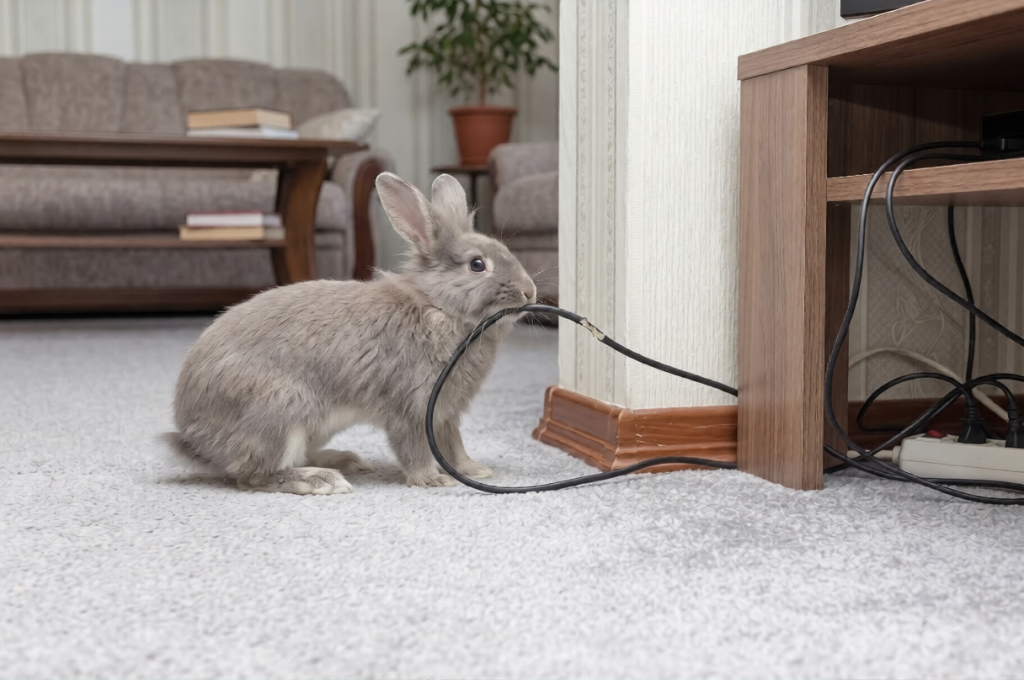
Destructive acts are rarely random; they are a form of non-verbal communication about unmet biological or emotional needs. To help you pinpoint the exact driver behind your pet’s habits, the table below connects specific target items to their underlying biological causes.
Decoding Destructive Target Items
| Item / Action Destroyed | Most Likely Biological Reason | Primary Root Need |
|---|---|---|
| Carpet Corners & Rugs | Burrowing drive & territory mapping | Dedicated dig box or ceramic corner tile |
| Electrical Cords | Clearing obstacles in pathway | Cord hider tubing or elevated wiring |
| Furniture Legs & Baseboards | Dental wear & firm wood resistance | Coarse grass hay & heavy apple branches |
| Blankets & Cushions | Nesting instincts & tactile shredding | Fleece fabric scraps or unbleached paper |
| Everything When Alone | Social boredom & quiet-hour energy | Extended foraging puzzles & toss toys |
| Sudden New Objects | Territorial adjustment & stress | Environmental stability & gradual introduction |
Because these behaviors often overlap—such as a rabbit shredding cardboard both to wear down teeth and relieve boredom—addressing the root drive with dedicated alternatives is the fastest way to protect your home.
A rabbit that destroys your furniture isn’t looking for something to ruin—they’re looking for something that behaves like bark, roots, soil, or nesting material. Once you provide those alternatives, many destructive behaviors naturally decline.
6. How Do I Stop My Rabbit From Destroying My House?
You cannot eliminate a rabbit’s natural urges, but you can control where they direct them. Success comes down to pairing effective redirection with physical protection.
Give Your Rabbit Better Things to Destroy
Instead of fighting your pet’s urges, provide items that satisfy specific instincts better than your furniture can. The table below outlines the best safe materials for each natural activity drive.
Approved Redirection Materials by Drive
| Activity Drive | Best Safe Choice | Why It Works |
|---|---|---|
| Chewing | Apple, willow, or pear branches | Delivers delicious, non-toxic wood resistance |
| Digging | High-sided dig box with shredded paper | Simulates deep soil excavation without carpet damage |
| Shredding | Untreated cardboard boxes & paper bags | Offers crisp tactile feedback and tearing sounds |
| Foraging | Snuffle mats & treat puzzle boards | Replaces quick meal bowls with extended mental effort |
Rabbit-Proof Your Home
While introducing enrichment, physically block access to high-value or dangerous targets. Install hard plastic spiral cord tubing or conduit over all electrical wires, or elevate them out of reach. Protect baseboards and wall corners with clear plastic corner guards, furring strips, or exercise pen panels.
Safety advice on keeping indoor rabbits safe from PDSA provides practical steps for protecting electrical wires and household surfaces. For carpet corners, anchor heavy ceramic tiles or woven seagrass mats directly over the spots your rabbit loves to excavate.
Give Your Rabbit Daily Enrichment
Redirecting a rabbit’s focus takes real mental engagement, not just a couple of wooden blocks on the floor. Try ditching the standard bowl, switching to the best rabbit food, and scattering pellets across a rug or snuffle mat to kickstart their foraging instincts.
You can also build cardboard mazes with plenty of tunnels to explore, rotating their chew toys weekly so new textures hold their interest. As noted by UC Davis School of Veterinary Medicine, refreshing a rabbit’s surroundings is one of the best ways to cut down on stress-driven habits and boredom.
Reward Appropriate Behavior
Rabbits respond remarkably well to positive reinforcement. When you notice your rabbit chewing a willow stick, digging in their dig box, or playing with a grass mat, immediately offer calm verbal praise (“Good chew!”) and a small treat, like a sprig of fresh cilantro or parsley. Over time, they learn that interacting with approved items brings delicious rewards and positive connection.
Five Mistakes That Make Destructive Behavior Worse
Even well-meaning owners can accidentally reinforce the exact habits they’re trying to stop. Avoid these common missteps that tend to escalate stress, destroy trust, and make household damage even worse.
- 1. Punishing or Yelling: Shouting, hitting, or chasing a rabbit instantly triggers their prey instincts. Trying to discipline a bunny wrecks the trust you’ve built and cranks up their stress, which rabbit behavior advocates strongly warn only teaches them to fear you rather than fix the issue.
- 2. Restricting Hay Access: Cutting back on grass hay limits molar grinding, forcing rabbits to search for hard furniture wood to wear down their growing teeth.
- 3. Limiting Exercise Time: Confining a rabbit to a cage or small pen builds up physical energy that explodes into frantic digging and baseboard chewing during out-time.
- 4. Leaving Loose Wires Exposed: Assuming a rabbit “knows better” with electrical cords invites dangerous bites; wires must always be physically tubed or elevated.
- 5. Relying on Small, Loose Toys: Lightweight plastic balls slide away easily when pushed. Rabbits prefer heavy, anchored items like thick tree branches or secured wall toys that provide real resistance.
Keep in mind: Anxiety can easily trigger defensive reactions like biting when a bunny is handled, and severe stress can even spark sudden rabbit aggression in an otherwise calm pet. To help them settle down safely, rely on calm, gentle redirection.
7. When Destructive Behavior Could Be a Problem

While chewing, digging, and shredding are completely normal daily activities for a healthy house rabbit, sudden shifts in behavior can occasionally indicate an underlying medical issue or severe environmental stress.
Normal Destructive Behavior
- Chewing wood, cardboard, or branches consistently throughout the day
- Digging in dedicated spots or carpet corners during active crepuscular hours
- Shredding paper or fabric with high energy and natural enthusiasm
Uncharacteristic or Medical Signals
- Sudden Onset: When a previously calm, mature rabbit turns frantically destructive overnight without any clear environmental trigger, it naturally leaves you wondering if something is wrong.
- Chewing Accompanied by Drooling: Gnawing on objects while experiencing drooling (slobbers) often indicates overgrown molars or painful dental spurs.
- Mouth Irritation: Severe oral discomfort or a mouth abscess can cause frantic chewing on hard surfaces as a response to jaw pain.
- Destruction Paired with Lethargy or Pain: Alternating between intense digging and huddled posture, accompanied by loud rabbit grinding teeth or distinct signs of pain.
- Loss of Appetite or Weight: Chewing frantically on non-food items while refusing grass hay or fresh greens is a major red flag for gastrointestinal distress or severe dental pain.
If your bunny shows any medical warning signs with their destructive behavior, pause training and check in with a rabbit-savvy vet first. In the meantime, listening closely to rabbit vocalizations will help you figure out if those sudden destructive bursts are driven by physical discomfort or simple daily play.
8. Frequently Asked Questions
Why does my rabbit chew walls and baseboards?
Baseboards and drywalls sit directly at eye level along key territorial boundaries and offer heavy, stable resistance. Wall corners are particularly appealing because they resemble natural tunnel obstacles. Adding plastic corner guards or offering fresh apple wood branches nearby gives them a safe, approved chewing alternative.
Why does my rabbit destroy cardboard so fast?
Cardboard provides an ideal combination of soft resistance and crisp sound. It yields easily to incisors while satisfying the biological urge to strip and tear materials.
Do rabbits outgrow destructive behavior?
Young rabbits usually hit their peak destructiveness during adolescence (4–18 months). While adults tend to settle down, the fundamental biological drives to chew, dig, and forage remain active throughout their lives.
Why does my rabbit only destroy one corner of the carpet?
Targeting a single spot usually indicates a texture preference, an ancestral burrowing habit, or a territorial boundary. Placing a heavy ceramic tile or a dedicated dig box directly over that spot redirects the behavior instantly.
Is my rabbit angry when they destroy things?
No. Rabbits do not act out of anger, spite, or revenge. What looks like destruction to humans is simply normal environmental management and play to a rabbit.
Are some rabbit breeds more destructive than others?
Breeds don’t determine destructiveness as much as energy level and age do. However, smaller, highly active breeds (like Netherland Dwarfs) and intelligent working breeds (like Belgian Hares) often require more daily enrichment to prevent boredom.
Why does my rabbit chew furniture but ignore chew toys?
Furniture legs and baseboards are heavy, anchored, and offer solid resistance. Many lightweight wooden toys slide away when pushed. Try securing chew toys to pen walls or offering heavier, thick tree branches that stay put.
Will spaying or neutering stop destructive behavior?
Spaying or neutering dramatically reduces hormone-fueled destruction, such as territorial carpet digging, frantic nesting, and restlessness. However, it will not eliminate non-hormonal, natural behaviors like dental chewing or daily foraging.
9. Final Thoughts
Discovering household damage can test your patience, but remember: your rabbit isn’t trying to misbehave. Every chew mark and dug-up carpet corner is simply a healthy animal trying to express fundamental survival instincts in a human space.
Success comes from redirection, not suppression. By rabbit-proofing high-risk spots, providing dedicated digging and foraging outlets, and meeting their biological needs, you can easily protect your home while keeping your rabbit happy and fulfilled.
Medical & Veterinary Disclaimer: bunnyowners.com is an informational resource for rabbit owners and enthusiasts. We are not veterinarians. The content on this website is not a substitute for professional veterinary care, diagnosis, or treatment. Always seek the advice of your veterinarian with any questions you may have regarding your pet’s medical condition, diet, or overall health.