
Veterinary & Affiliate Disclaimer: Bunnyowners.com shares educational rabbit care resources, not professional veterinary advice. Always consult a qualified veterinarian regarding your rabbit’s medical, dietary, or behavioral needs. This post may also contain affiliate links; as an Amazon Associate and affiliate partner, we earn from qualifying purchases at zero extra cost to you.
Rabbits are natural-born architects, but when that architectural drive turns into frantic, non-stop scratching at 3:00 AM, it can leave any pet parent feeling completely overwhelmed. Most owners find themselves searching for answers because they want to know if this disruptive behavior is normal, what it means for their pet’s mental state, and how to safely stop it without causing further anxiety.
Rabbits dig in their cages due to a natural, instinctual urge to burrow, rearrange bedding, or manage their immediate territory. However, frequent, frantic, or repetitive cage scratching is typically triggered by environmental frustration, boredom, insufficient enclosure space, or lack of mental stimulation. Managing this behavior requires expanding their physical boundary, addressing hormonal shifts, or redirecting their claws to safe digging alternatives.
Understanding the subtle nuances of your rabbit’s behavior can help you determine whether they are simply redecorating their space or pleading for a change in their daily routine. The following breakdown will explore the biological catalysts behind cage scratching, identify when the behavior becomes a medical risk, and provide actionable, stress-free solutions to restore peace to your home.
1. Is It Normal for Rabbits to Dig in Their Cage?
Before staging an intervention, it is vital to understand that you cannot fully train a rabbit out of digging—nor should you want to. In the wild, European rabbits (Oryctolagus cuniculus), from which all domestic rabbits descend, survive by excavating complex underground warrens.
This biological blueprint does not vanish just because a rabbit lives indoors. Domestic rabbits retain every ounce of this wild drive. Therefore, cage digging alone is not automatically a behavioral problem or a sign of an unhappy pet. However, context is everything. You can typically determine if the behavior is normal by evaluating a few key factors:
Table 1: Assessing Normal vs. Problematic Digging Contexts
| Key Evaluation Factor | Normal Instinctual Behavior | Potential Problematic Sign |
|---|---|---|
| Intensity & Duration | Light smoothing or digging for 5–10 minutes before settling. | Continuous, frantic scratching for hours at a time. |
| Age Dynamics | Surges in juveniles (under 6 months) as development spikes. | Sudden onset in senior rabbits with historically calm habits. |
| Breed Dispositions | High frequency in high-energy breeds (e.g., Belgian Hares, Rexes). | Heavy, obsessive focus in naturally low-energy, calm breeds. |
Quick Summary: Occasional cage digging is completely normal rabbit behavior, particularly during their peak active morning and evening hours.
2. Why Rabbits Dig in Their Cage
The most straightforward explanation is often the truest: your rabbit’s biology is telling them to build a home. In a wild setting, corners and slopes are the ideal starting points for stable tunnels.
In a domestic enclosure, the solid corners of a cage or the edges of a litter box act as behavioral triggers, mimicking the natural topography that prompts a rabbit to start a burrow. Because the plastic or metal floor refuses to give way, the rabbit may continuously scratch in an attempt to achieve the depth their instincts tell them should be there.
This property claiming routine doesn’t stop with claws, either; it is heavily paired with scent glands, which you can read up on in my guide to the mechanics of rabbit chinning. For more insight on wild burrowing habits, you can look at the University of Michigan Museum of Zoology Oryctolagus cuniculus Profile.
Boredom and Lack of Stimulation
This is one of the most common catalysts for obsessive cage digging. Rabbits are highly intelligent, inquisitive animals with active minds. If they are confined to a standard, small cage for long stretches of time without structural variety or enrichment toys, they will quickly run out of things to do.
When a rabbit has no puzzles to solve, no safe wood to chew, and no varied forage to seek out, pent-up mental and physical energy has nowhere to go. Digging then becomes a self-entertainment behavior, a repetitive habit adopted purely to pass the hours of confinement. The importance of preventing understimulation is outlined in the RSPCA Rabbit Environment Guide.
Quick Summary: Rabbits often dig in their cages when they are bored or do not have enough mental and physical stimulation to occupy their minds.
Trying to Get Out of the Cage (Barrier Frustration)
Rabbits are highly territorial animals that view the wider room or home as their extended foraging grounds. They generally dislike prolonged confinement.
When a rabbit focuses their digging specifically near the cage door, the latches, or the perimeter edges, they are experiencing what animal behaviorists refer to as barrier frustration. This occurs when an animal can clearly perceive an available environment outside their immediate boundary but is physically blocked from accessing it.
Intelligent, high-energy rabbits will frequently pair this localized digging with bar biting, creating a loud, rhythmic protest aimed entirely at escaping the enclosure. Learn more about optimal enclosure parameters from the House Rabbit Society Housing Guide.
Nesting or Hormonal Behavior
If you are dealing with an unspayed female rabbit, a sudden onset of frantic, localized cage digging is frequently tied to reproductive hormones. Intact females experience strong biological urges to prepare a safe, excavated birthing den.
Key details about hormonal digging include:
- False Pregnancies: This behavior can occur even if she has never been near a male rabbit, a phenomenon known as a false pregnancy (pseudopregnancy).
- Bedding Manipulation: During these hormonal cycles, you will likely observe her aggressively rearranging her bedding, moving hay to a specific corner, and even pulling fur from her chest and belly to line the area.
- Gender Differences: While intact males can also exhibit intense, hormonal digging driven by territorial frustration, the specific “den-building” focus is predominantly a female trait. To recognize these shifts, read the PDSA Rabbit Hair Loss & Nesting Guide.
Quick Summary: Female rabbits may dig in their cage while preparing a nesting area, especially during hormonal periods or false pregnancies.
Stress or Anxiety
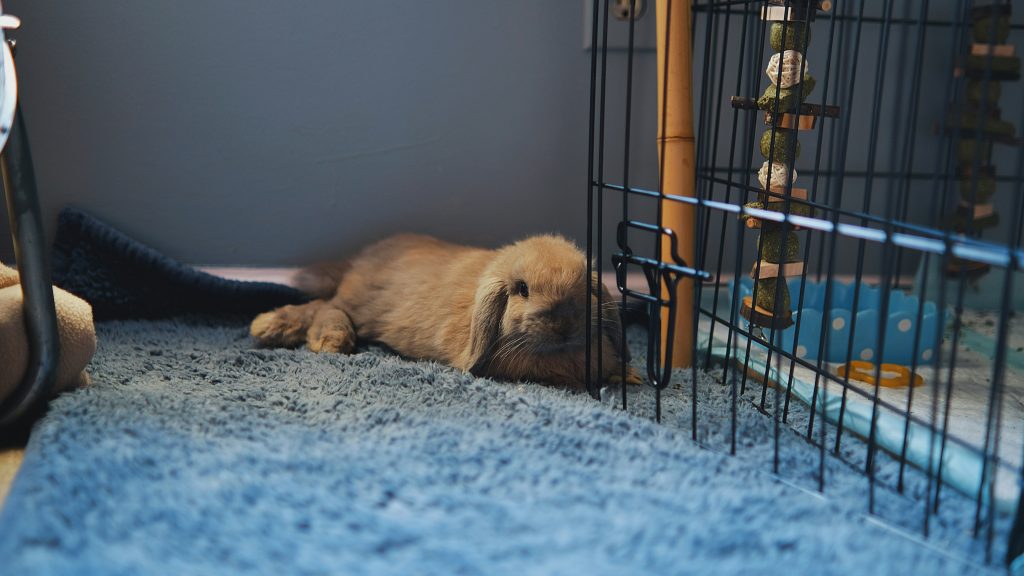
Frantic, erratic digging can be a displacement behavior caused by environmental stress. Because rabbits are prey animals, their instinct when frightened is to flee or hide underground.
If their cage is located in a loud, high-traffic environment, near the scent of a predator (like a household cat or dog), or lacks proper hiding spaces, the rabbit can feel profoundly vulnerable. Unlike normal instinctual digging, stress-induced scratching tends to look chaotic, tense, and desperate.
It is often accompanied by other clear distress signals, such as:
- Frequent thumping
- Hiding away for hours
- Hyperventilating or heavy breathing
- A sudden reduction in appetite
Rearranging Their Space
On a more benign note, rabbits are meticulous interior designers. They have distinct preferences for how their territory should be laid out. From an observational standpoint, a rabbit will often use their front paws to transition from a light smoothing motion to a brief, high-intensity dig when altering their immediate sleeping or resting quarters.
For instance, observation of my house rabbits, Mocha and Chino, reveal how distinct their individual redecorating styles can be. While one might carefully push a blanket into a corner with focused paw-swipes, the other might engage in aggressive, rapid scratching to gather the material into a perfectly contoured pile before settling down for a nap. This functional landscaping is highly common right before a rabbit settles down to sleep or melt into a relaxed “flop.” To better understand structural territorial adjustments, you can look at my broader list of rabbit behavior guides.
Table 2: Behavioral Drivers and Targeted Solutions
| Primary Behavioral Root Cause | Common Localized Triggers | Immediate Practical Solution |
|---|---|---|
| Natural Burrowing Instinct | Corner placements, litter box boundaries | Provide loose substrate or safe cardboard dig boxes |
| Boredom & Understimulation | Prolonged isolation, empty enclosure layout | Rotate toys, add chew blocks, offer puzzle feeders |
| Barrier Frustration | Locked cage door, visible open rooms | Increase daily out-of-cage roaming time |
| Hormonal & Nesting Urges | Intact reproductive status, false pregnancy | Schedule a spay or neuter veterinary consultation |
| Stress or Environmental Fear | Predator scents, loud noises, high-foot-traffic areas | Relocate enclosure to a quiet, secure room |
3. Why Rabbits Dig in the Corners of the Cage
If your rabbit ignores the center of the cage but spends hours aggressively targeting the far corners, you are witnessing a very specific behavioral sub-intent.
Table 3: The Corner-Digging Catalyst Framework
| Sequential Stage | Behavioral Process | Architectural Context |
|---|---|---|
| 1. The Security Search | The rabbit seeks out a secure boundary zone to rest or expand territory. | Enclosure corners provide structural safety on two distinct sides. |
| 2. Ancestral Triggering | Instinctive drives prompt the rabbit to start a burrow vector. | In the wild, right angles and natural slopes form structural tunnel baselines. |
| 3. Hard Surface Resistance | Persistent scratching ensues against the floor tray. | The solid plastic or wire resists claw movement, fueling cyclical frustration. |
| 4. Substrate Target Fixation | Claws focus intensely on gaps or carpet visible beneath the tray lip. | External environmental cues (fibers, scents) turn curiosity into an obsessive task. |
In the wild, a corner or a sharp angle represents the safest, most structurally sound location to initiate a tunnel vector because it minimizes the risk of a ceiling collapse. In captivity, corners are the only zones where a rabbit feels completely enclosed and protected on two sides simultaneously, making it their primary structural target.
Corner digging is heavily reinforced by the physics of a cage. If the cage sits on top of a carpeted floor, the rabbit can often smell or see the tempting fibers just beneath the lip of the plastic tray. This can turn simple curiosity into a dedicated project to dig through the plastic to reach the soft texture underneath.
Quick Summary: Rabbits commonly dig in cage corners because enclosed edges feel safest and most natural for burrowing behavior.
4. Why Rabbits Dig in Their Cage at Night
Few things are more frustrating than being awoken by the sound of plastic rattling and claws scraping. However, your rabbit isn’t trying to keep you awake on purpose; they are simply following their biological clock.
Rabbits are crepuscular, meaning they are naturally most active, alert, and energized during the twilight hours of dawn and dusk, extending into the night. While the human household is winding down to sleep, the rabbit’s internal clock is signaling that it is peak foraging and excavation time.
If your bunny is confined to a cage during these hours with no other outlet, that surge of midnight energy gets channeled directly into the cage floor. This nocturnal noise complaint is a classic sign that your pet has too much pent-up energy and needs a more constructive routine before bedtime. You can check out my full dive into what rabbits do at night for a deeper breakdown of these midnight bursts, while the RWAF Behavior Guide offers excellent detailed insights into normal lagomorph activity cycles.
Quick Summary: Rabbits often dig in their cages at night because they become more active during evening and early morning hours.
5. Signs the Digging May Be a Problem
While digging is a natural right for any rabbit, there is a line where a normal habit transitions into a physical or psychological hazard. Pet owners should actively monitor for structural and physical warning signs.
Obsessive or Constant Digging
If your rabbit is engaged in repetitive, non-stop scratching to the point where they cannot be distracted by treats, refuse to rest, or appear completely locked into a compulsive loop, the behavior has surpassed normal limits. This level of fixation points to chronic environmental frustration or severe anxiety.
Injured Nails or Bleeding Feet
This is the most critical physical risk. Continuous scratching on hard, unforgiving surfaces like smooth plastic trays or abrasive wire grids can cause severe physical wear.
Rabbits do not have protective pads on their paws like dogs or cats; they rely entirely on thick fur to cushion their feet. Prolonged friction can strip away this fur, leading to a painful condition known as pododermatitis (sore hocks), or cause them to snag, tear, and split their toenails down to the quick.
Table 4: Impact of Enclosure Flooring Types on Digging Safety
| Enclosure Floor Type | Digging Risk Level | Potential Health Impact | Recommended Mitigation |
|---|---|---|---|
| Wire Grids / Mesh | Extremely High | Severe risk of torn nails, broken toes, and rapid development of sore hocks. | Cover immediately with solid wood boards, tile, or heavy mats. |
| Slick Plastic Trays | Moderate | Causes friction burns on hocks; provides zero traction, worsening frustration. | Add textured grass mats or layered fleece blankets. |
| Fleece Liners / Mats | Low | Safely absorbs impact; allows satisfying fabric bunching without skin abrasion. | Secure edges down to prevent the rabbit from chewing underneath. |
Aggressive or Destructive Behavior
When cage digging is paired with constant lunging at the bars, relentless cage shaking, or destructive chewing of non-food items, it is a clear expression of severe barrier frustration. If you notice these defensive habits bleeding into their human interactions, it is crucial to research why a rabbit becomes territorial to address the spatial stress underlying the aggression.
Sudden Changes in Behavior
A rabbit that has been calm for years but suddenly begins digging excessively overnight should never be ignored. Behavioral shifts are frequently a rabbit’s only way of communicating physical distress.
Rabbits often mask hidden internal discomfort, GI issues, or dental pain by adopting repetitive, compulsive displacement behaviors like frantic scratching. For comprehensive symptoms of physical discomfort, refer to the VCA Animal Hospitals Guide on GI Stasis in Rabbits.
6. How to Stop a Rabbit From Digging in Their Cage
The solution to unwanted cage digging is never to suppress the behavior through punishment, but rather to manage it through smart environmental redirection.
Provide More Exercise Time
The absolute most effective way to eliminate barrier frustration and midnight digging is to grant your rabbit more freedom. Ensure your rabbit receives a minimum of 4 to 6 hours of supervised exploration time outside of their cage every single day in a safely rabbit-proofed room. A rabbit that has spent their evening sprinting, hopping, and exploring will naturally use their cage time to rest rather than protest.
Add Digging Alternatives (Redirection)
Instead of forcing your rabbit to scratch at a solid floor, give them a dedicated space where their claws can actually accomplish something. Daily observational tracking with household rabbits like Mocha and Chino underscores how effective structural redirection can be; when provided with a multi-layered foraging mat or a heavy fleece blanket inside their enclosure, their focus shifts away from barrier frustration entirely. For a complete look at managing habitat frustrations, check out my Definitive Guide to Rabbit Behavior.
You can build a highly effective, low-cost DIY dig box in under five minutes:
The 5-Minute DIY Dig Box Blueprint
- Take a clean, shallow cardboard box or a storage plastic tub.
- Fill it with safe, shreddable materials such as uninked packing paper, clean play sand, or a thick layer of orchard grass and timothy hay.
- Scatter a few pellets or dried botanical treats throughout the layer to encourage natural foraging.
Place this box inside their enclosure or in their main play area. Providing this structured redirection successfully interrupts the psychological feedback loop of barrier frustration without causing environmental stress. For more activity setups, review the Blue Cross Small Pet Enrichment Tips.
Upgrade the Enclosure Size
If your rabbit is spending long periods inside a standard, commercial pet store cage, the simplest truth may be that the cage is far too small. A proper rabbit enclosure should be large enough for them to take at least three consecutive hops, stand completely upright on their hind legs without their ears touching the ceiling, and comfortably stretch out fully.
Upgrading to a spacious modular exercise pen (X-pen) gives them the room they need to move, automatically lowering their baseline frustration.
Table 5: Enclosure Space vs. Rabbit Behavior Dynamics
| Housing Type | Minimum Size Standard | Impact on Baseline Behavior | Digging Frequency |
|---|---|---|---|
| Standard Pet Store Cage | Typically 3′ x 2′ or smaller | High confinement stress, muscle atrophy, persistent pacing habits. | High (Frustration-driven boundary scratching) |
| Modular Exercise Pen (X-Pen) | At least 4′ x 4′ or 16 sq. ft | Allows standard hops, upright standing space, separate play and bathroom zones. | Moderate to Low (Mostly localized rearranging) |
| Free-Roam Room Enclosure | Full room layout | Full architectural expression, low boundary stress, high physical exhaustion. | Very Low (Redirected to designated floor zones) |
Increase Mental Enrichment
Keep their minds busy so their paws don’t have to be. Introduce food puzzles, complex foraging mats, and heavy willow balls or applewood chew sticks. Rotating these enrichment items every few days keeps the environment feeling novel and engaging, ensuring they focus on solving puzzles rather than digging out of corners.
Spaying or Neutering
If the digging is accompanied by nesting behaviors, territory marking, or general moodiness, scheduling a consultation with a rabbit-savvy veterinarian to have your rabbit spayed or neutered is highly recommended. Hormonal drives are incredibly powerful, and fixing your rabbit significantly reduces the biological frustration that fuels obsessive digging.
The broad behavioral benefits of sterilization are highlighted by the House Rabbit Society Spaying and Neutering Basics.
7. What You Should Never Do
When addressing cage digging, avoiding harmful management techniques is just as important as implementing helpful ones.
- Do Not Punish the Behavior: Never hit the cage walls, scream at your rabbit, or spray them with water. Rabbits do not understand corrective punishment; doing this will only terrify them, shatter their trust in you, and escalate their baseline stress, which ironically makes the frantic digging worse.
- Do Not Ignore Broken Skin: Never assume a bald patch or a red spot on their heel will heal on its own. Open wounds on a rabbit’s foot can quickly invite deep bacterial infections that are exceptionally difficult to treat.
Quick Summary: Punishing a rabbit for digging usually increases stress and can make the behavior worse.
8. When to Contact a Veterinarian

While most cage digging can be resolved with lifestyle upgrades, you should contact a rabbit-savvy veterinarian immediately if you notice visual or structural changes in your pet.
Table 6: Distinguishing Behavioral Digging From Medical Emergencies
| Sign or Associated Symptom | Likely Behavioral Cause | Urgent Medical Warning |
|---|---|---|
| Appetite & Eating Habits | Readily runs to the food bowl; normal hay intake. | Complete refusal to eat pellets or hay for more than 4–6 hours. |
| Physical Paw & Foot Condition | Clean fur padding; neat, uncracked nail tips. | Missing fur, raw skin, bleeding, or weeping fluid on the hocks. |
| Post-Digging Posture | Relaxes into a flat flop, lounge position, or standard loaf. | Repeated hunched pressing of the abdomen against the floor; grunting. |
| Fecal Pellet Production | Normal round size, dry texture, and stable output frequency. | Small, teardrop-shaped pellets, strung together with hair, or zero output. |
If you suspect your rabbit’s digging patterns correlate with GI pain, look at the emergency response guidelines provided by the Veterinary Emergency Group Rabbit Appetite Protocol.
9. Frequently Asked Questions (FAQ)
Can a rabbit break its nails from digging in a cage?
Yes. If a rabbit digs continuously on hard surfaces like slick plastic trays or metal wire grids, their nails can easily catch, split, or tear down to the sensitive quick, causing pain and bleeding. Keeping their nails trimmed and providing soft dig boxes can prevent this issue.
Why does my rabbit dig in their litter box specifically?
The litter box is inherently full of loose, easily moveable substrate, making it prime real estate for burrowing instincts. If your rabbit is constantly kicking litter everywhere, try switching to a larger box with higher sides, or provide a separate paper-filled dig box nearby to satisfy that specific urge.
Does spaying or neutering completely stop cage digging?
While spaying or neutering dramatically reduces hormonal, nesting, and territorial digging behaviors, it will not eliminate the habit entirely. Fixed rabbits will still dig out of normal instinct, boredom, or barrier frustration if their environmental needs are neglected.
Is cage digging a sign of depression in rabbits?
Cage digging is more accurately classified as a sign of frustration, boredom, or high stress rather than clinical depression. However, if a rabbit’s environment never changes and they are kept in chronic confinement, that frustration can eventually morph into lethargy and withdrawal.
10. Conclusion
At the end of the day, a rabbit digging in their cage is simply a rabbit trying to tell you something. Whether they are driven by ancient ancestral instincts to build an underground warren, trying to burn off an evening energy spike, or expressing genuine frustration with a cramped space, the behavior is an invitation to evaluate their environment. By expanding their territory, introducing dedicated digging alternatives, and keeping their sharp minds engaged, you can successfully transform a loud nocturnal nuisance into a happy, health-focused, and beautifully balanced routine for your bunny.
Medical & Veterinary Disclaimer: Bunnyowners.com is an informational resource for rabbit owners and enthusiasts. We are not veterinarians. The content on this website is for educational purposes only and is not a substitute for professional veterinary advice, diagnosis, or treatment. Always consult a qualified veterinarian with any questions or concerns regarding your pet’s health, medical conditions, diet, or overall care. If you have concerns about your rabbit’s health, it’s always best to reach out to a veterinarian rather than relying solely on information found online.