
Veterinary & Affiliate Disclaimer: Bunnyowners.com shares educational rabbit care resources, not professional veterinary advice. Always consult a qualified veterinarian regarding your rabbit’s medical, dietary, or behavioral needs. This post may also contain affiliate links; as an Amazon Associate and affiliate partner, we earn from qualifying purchases at zero extra cost to you.
Rabbits are essentially the valedictorians of the School of Stoicism. In the wild, showing even a microscopic hint of vulnerability is a formal invitation for a hawk to check the daily specials. This survival instinct makes their subtle vocalizations, like teeth grinding, a complex linguistic riddle for owners. If you are currently sitting next to your bunny wondering if you should reach for the vet’s number or the parsley, you need to differentiate the “purr” from the “pain” immediately.
Rabbit teeth grinding is either a soft, rhythmic “tooth purr” signaling absolute contentment or a loud, grating sound known as bruxism that indicates severe pain. To tell the difference fast, look for a relaxed posture during petting for a purr, versus a hunched, tense body and a sudden refusal of treats for a pain-induced crisis. While a purring bunny is effectively in a state of Zen, loud grinding paired with lethargy or a lack of droppings is a medical emergency that requires immediate veterinary intervention.
Understanding this distinction is the cornerstone of responsible rabbit health and husbandry. While the “tooth purr” is a badge of honor for a bonding owner, the “pain grind” (bruxism) is often the first audible symptom of serious internal distress. By acting as a researcher of your rabbit’s daily habits, you can decode these silent signals before a minor discomfort turns into a life-threatening crisis.
1. How to Tell the Difference
To triage your rabbit’s condition in under ten seconds, you must look past the sound and evaluate the physiological context. As a researcher, I have analyzed the “metabolic cost” of pain in small herbivores: they hide it until the energy required to mask the symptom exceeds their survival threshold. This “metabolic gap” is where many owners lose valuable time, assuming that because the rabbit isn’t screaming, the situation isn’t dire.
Checking for Purring
Does the grinding stop when you stop petting? Does the rabbit nudge you for more or lower their head back into the “pet me” position? If the vibration is linked specifically to your interaction, it is a vocalization of comfort. In a state of bliss, the rabbit’s muscles are lax. You can perform a “tension test” by observing the shoulder blades; in a purring rabbit, the shoulders are rounded and soft, whereas, in a pained rabbit, they appear angular and sharp due to muscular contraction. Trust the shoulder blades. They don’t lie.
Testing Appetite
Offer a high-value treat, such as a sprig of cilantro, a small piece of banana, or a fragrant rose petal. A pained rabbit will almost always turn their head away—not because they aren’t hungry, but because the biological drive for survival (pain management) has overridden the drive for foraging. A happy “purring” rabbit will transition immediately from clicking to chewing without hesitation. If the rabbit sniffs the treat and then retreats to a corner, the grinding is 100% pain-related.
Observing Posture
A relaxed rabbit “melts” into the floor, exhibiting the “flop” or the “relaxed loaf.” Their weight is distributed evenly across their haunches. A pained rabbit “guards” their space. They sit in a rigid, hunched position, often with their eyes wide or partially squinted in a grimace. If they look like they are vibrating with effort rather than relaxation, assume the worst.
2. Comparison of Symptoms
To the untrained ear, a grind is just a grind. However, once you observe the mechanical frequency and the accompanying markers, the difference becomes stark. Use the table below to categorize the sounds you are hearing with scientific precision. Don’t let your optimism cloud the data.
Table 1: Visual and Auditory Cues
| Feature | Soft “Tooth Purring” | Loud “Pain Grinding” |
|---|---|---|
| Volume | Very quiet; felt more than heard | Audible from across the room |
| Frequency | Rhythmic, like a heartbeat | Irregular or jagged “crunching” |
| Body Language | Relaxed, “flopped,” or loafing | Hunched, tense, or “belly pressing” |
| Eye Shape | Half-closed or “soft” almond | Wide, bulging, or tightly squinted |
| Nose Twitch | Slow, steady, or stopped | Rapid or completely frozen |
| Context | During petting or resting | Occurs when the rabbit is isolated |
| Response to Food | Enthusiastic | Refusal or very slow interest |
3. How Rabbit Teeth Work
To understand why rabbits grind their teeth, we must look at the unique evolution of lagomorph dentition. Unlike humans, whose teeth are “brachydont” (limited growth), rabbits possess “elodont” teeth. This means their premolars and molars have no true anatomical roots and grow continuously throughout their lives at a rate of approximately 2–3 mm per week.
Continuous Tooth Growth
Rabbits are designed to process massive amounts of abrasive silica found in grasses and hay. The lateral (side-to-side) motion of the jaw serves as a grinding mill. When the jaw moves, the enamel ridges of the upper and lower teeth slide across each other. This is a highly efficient way to break down cellulose, but it also means that any misalignment (malocclusion) creates immediate friction. When a rabbit is in pain, they clench these ridges together, creating a sound that is essentially the grinding of bone-like structures under high pressure.
Jaw Muscle Function
The masseter muscle in a rabbit is incredibly powerful relative to its size. In a state of relaxation (purring), the muscle engages in low-tension, rapid contractions. This creates the “tooth purr.” When the rabbit is in pain, the sympathetic nervous system triggers a “fight or flight” response, causing the masseter to clench. The resulting bruxism is the sound of those enamel ridges being forced together under high pressure.
Sound and Skull Shape
The rabbit’s skull is largely hollow in certain areas to keep it light for rapid flight. These hollow chambers act as acoustic resonators. A “purr” resonates gently through the sinus cavities, which is why you feel it in their forehead. A “pain grind” vibrates against the jawbone and the base of the skull, creating a much sharper, “crunchier” sound that carries further in the air because the vibration is being amplified by the bone rather than the soft tissues.
4. Normal Grinding (Tooth Purring)
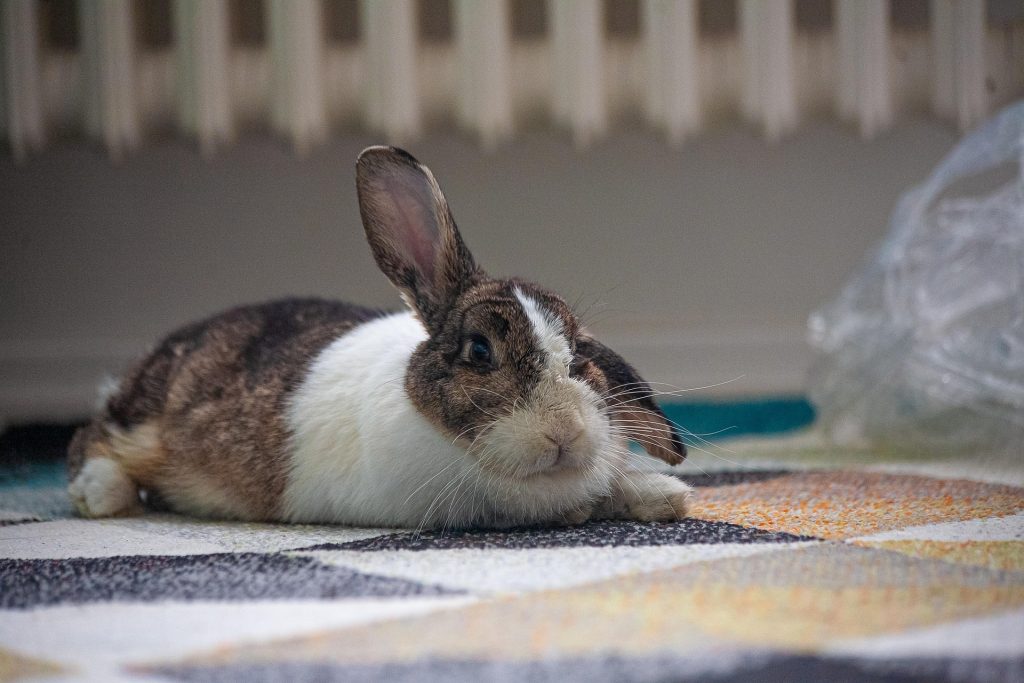
The “tooth purr” is a mechanical vibration indicating the parasympathetic nervous system is in control. Much like a cat’s purr, it is a self-soothing mechanism that reinforces a state of relaxation. In my research-led observations, I’ve found that this sound is the ultimate validator of a successful human-rabbit bond.
Social Signaling
Rabbits are social creatures that rely on grooming (allogrooming) to establish hierarchy and safety. When you pet a rabbit and they begin to purr, they are effectively acknowledging your role as a “safe” member of the colony. It is an evolutionary “all-clear” signal. If they stop purring when you stop petting, they are using the sound as a communication tool to request more interaction.
Self-Soothing Behavior
Mocha and Chino, my resident bonded rabbits, often engage in synchronized purring after a meal. This isn’t just because they are full; it is a physiological reset. By chattering their teeth lightly, they are signaling to their bodies that it is time to transition into “rest and digest” mode. I’ve noted that Mocha’s purr is slightly more high-pitched than Chino’s, likely due to subtle differences in jaw alignment, yet the “relaxed eye” signal remains consistent between them.
Signs of a Happy Rabbit
A purring rabbit will often exhibit the “Happy Loaf” posture.
- Tucked Front Paws: Paws are completely hidden under the chest fluff, indicating they don’t feel the need to make a quick escape.
- Spread Rear End: The hips widen, and the tail is relaxed.
- Relaxed Ears: In lop breeds, the ears may sway slightly with the vibration; in up-eared breeds, the ears will lay back softly against the neck, not pinned but resting.
5. Painful Grinding (Bruxism)
The “pain grind” (bruxism) lacks the rhythmic “musicality” of a purr. It is often sporadic, reflecting the “waves” of pain associated with gastrointestinal cramping or the sharp irritation of dental spurs. I categorize this as a “distress vocalization without a voice.”
Sound Frequency of Pain
Pain grinding is rarely constant. It often peaks when the rabbit attempts to shift positions. You may hear three or four loud, crunchy grinds followed by a minute of eerie silence as the rabbit tries to “still” their body to avoid further pain. This irregular pattern is a significant diagnostic marker for internal gas, which often comes in “waves” of pressure.
Why Rabbits Hide Pain
Rabbits are masters of the “silent scream.” In the wild, vocalizing pain is a death sentence. Bruxism is one of the few leaks in their defensive stoicism. According to the PDSA, by the time you hear loud grinding, the pain is already significant enough that the rabbit can no longer prioritize silence over the need for a physical coping mechanism.
Stress vs. Pain
While less common, extreme fear can cause a rabbit to grind their teeth. If a rabbit is in a new environment or smells a predator, they may engage in a frantic, fast-paced grind. This is different from pain bruxism as it is usually accompanied by a “frozen” nose and wide, “whale-eye” (seeing the whites of the eyes).
6. Signs of Pain in Body Language
A rabbit in pain doesn’t just grind; they shift their weight awkwardly to protect their vitals. This is a visceral reaction to abdominal distress or skeletal trauma. In research, this is often called “guarding behavior.”
Belly Pressing
When a rabbit has gas, the pressure in the cecum is immense. To alleviate this, the rabbit will press their stomach flat against the floor, then suddenly hop up and rearrange themselves because they can’t find comfort. This restlessness, paired with grinding, is a diagnostic “smoking gun” for gas pain.
Facial Signs of Pain
Veterinary science has quantified rabbit pain through the Rabbit Grimace Scale.
- Orbital Tightening: The eyes are narrowed or squinted, unlike the “half-closed” eyes of a happy rabbit.
- Cheek Flattening: The area around the nose and mouth looks drawn and tight.
- Whiskers: Instead of being fan-like and relaxed, they are bunched or pointing downward, reflecting facial muscle tension.
Low Ear Temperature
When a rabbit is in intense pain, their body begins to prioritize blood flow to the core organs, moving it away from the extremities. If you hear grinding and the ears feel “refrigerator cold,” the rabbit may be entering shock. This is a critical indicator that requires immediate veterinary intervention to stabilize the core temperature.
7. Causes of Painful Grinding
Pain grinding is frequently the first audible symptom of a slowing digestive tract or dental trauma. As a researcher of lagomorph physiology, I focus on these two primary domains as they account for over 90% of bruxism cases.
Gastrointestinal (GI) Stasis
Gastrointestinal Stasis (Ileus) occurs when the muscular contractions of the stomach and intestines slow down or stop. This leads to a buildup of harmful bacteria and gas. In my research with Mocha and Chino, I’ve observed that even a minor change in the “gut-clock” can lead to visible discomfort. Acting “normal” is a deeply ingrained survival instinct; even my own pets will try to hide discomfort until the metabolic cost is too high to ignore.
How the Gut Fails
The cecum is a large fermentation vat. When stasis occurs, the pH of the cecum shifts from its healthy range of 6.0–6.8 toward dangerous acidity. This causes the bacteria to produce gas instead of healthy cecotropes. This distension is what causes the “belly-pressing” and the grinding sounds. According to Veterinary Partner, stasis is almost always a secondary symptom of pain, stress, or a low-fiber diet.
Overgrown Teeth and Spurs
Because rabbit teeth grow so rapidly, they must be perfectly aligned. If the alignment is off, sharp enamel spikes called spurs can form. These spurs act like needles, stabbing the tongue or the cheek every time the rabbit swallows. This mechanical agony results in loud, rhythmic grinding as the rabbit tries—unsuccessfully—to wear down the painfully overgrown teeth and dental disease landmarks themselves.
8. Quick Decision Tree
To help you act as a first-responder for your pet, use this logical flow to evaluate their current status. Trust the litter box data over their behavior every single time.
Table 2: Rapid Diagnostic Tree
| Question to Ask | If YES | If NO |
|---|---|---|
| Is the rabbit eating treats? | Likely Normal | Emergency / Warning |
| Is grinding loud? | Emergency / Warning | Likely Normal |
| Is posture “hunched”? | Emergency / Warning | Likely Normal |
| Does it only happen during pets? | Normal | Investigate Further |
| Are droppings normal in size? | Normal | Emergency / Warning |
Hair in Droppings
If you check the litter box and see droppings connected by hair (a “string of pearls”), this indicates that hair is slowing down the gut. This often precedes the grinding and stasis cycle. It’s a precursor to the “Cognitive Gap” where the rabbit’s brain is still telling it to play, but the body is starting to fail.
No Droppings
If the litter box has been completely empty for several hours, and you hear grinding, the rabbit’s digestive process is grinding to a halt. In this scenario, you are tracking a dangerous level of gastrointestinal hypomotility and constipation.
9. When to See a Vet
Rabbits have a high metabolic rate; their health can spiral within hours. Catching grinding in the “Golden Window” (the first 4–6 hours) significantly increases the success rate of recovery.
Table 3: Actionable Timeline
| Timeframe | Observation | Action Required |
|---|---|---|
| 0–2 Hours | Quiet grinding; rabbit still eating | Monitor behavior and poops closely |
| 2–6 Hours | Sluggish appetite; persistent grinding | Call your vet for an appointment today |
| 6+ Hours | Refusing food; loud grinding; cold ears | Seek an ER Vet Immediately |
Signs of Dehydration
When a rabbit is in pain, they stop drinking. A dehydrated gut is an impacted gut. If the timeline reaches the 6-hour mark, the rabbit likely needs subcutaneous fluids that only a vet can safely administer to restart the digestive engine. If you note your pet is completely refusing water, fluid balance drops catastrophically fast.
Shock Symptoms
A grinding rabbit that is also cold is a rabbit in shock. Their body temperature can drop below the safe range of 101°F–103°F very quickly. If you don’t have a thermometer, the “Ear Test” is your best proxy—if they feel like ice, move fast. If left unaddressed, the rabbit faces a high probability of entering a fatal systemic shock or sudden death phase.
10. How to Prevent Pain
The best way to ensure grinding remains a “purr” is to prioritize dental wear and gut motility. Prevention is always cheaper and less stressful than an emergency vet bill.
Table 4: Preventive Strategies
| Focus Area | Action | Purpose |
|---|---|---|
| Diet | 80% high-quality grass hay | Mechanical wear on teeth and fiber for gut |
| Hydration | Heavy ceramic water bowls | Encourages higher water intake |
| Enrichment | Chew toys and foraging mats | Lowers cortisol and prevents stress grinding |
| Medical | Annual dental checkups | Catches spurs early |
Best Hay for Dental Health
Not all hay is created equal. Identifying the best hay types for adult rabbits is critical. Timothy hay is the gold standard for dental wear due to its high silica and fiber content. For older rabbits with dental issues, Meadow hay might be softer, but it provides less mechanical wear. Variety in hay encourages foraging behavior, which keeps the masseter muscles toned.
Water Intake Methods
Research consistently shows that rabbits drink more from a bowl than a bottle. More water means more fluid in the gut, which prevents the painful gas and stasis that cause bruxism. A well-hydrated gut is the primary defense against the “Metabolic Reset” that occurs during stasis. For a complete perspective on establishing protective environmental baselines, an optimized high-fiber diet guide details how proper forage lengths maintain baseline muscle motility.
11. Emergency Home Care
If you suspect pain-related grinding, you must transition from researcher to first-responder.
Towel Wrapping
If the rabbit is in pain and you need to transport them, wrap them in a soft towel. This provides security and helps maintain their body temperature. Ensure the towel is not too tight; you want to mimic the feeling of being in a safe burrow, reducing the stress that exacerbates bruxism.
Abdominal Massage
If the rabbit is grinding and hunched, you can perform a gentle abdominal massage.
- Positioning: Place the rabbit on a flat surface.
- Technique: Gently lift the hindquarters slightly and use your fingertips to massage the belly in circular motions.
- Observation: If the grinding intensifies or the rabbit struggles, stop immediately—this indicates the pain is too acute for manual help.
Using Warmth
A pained rabbit loses heat. Place a warm (not hot) water bottle wrapped in a towel near them. Never use a heating pad on a high setting, as rabbits can easily sustain burns and cannot always move away if they are in extreme pain.
Finding a Specialist
Regular dog-and-cat vets often lack the specialized equipment needed for lagomorphs. Ensure your vet is listed with a specialist directory. Waiting overnight for a specialist is safer than taking a rabbit to a vet who may misdiagnose a blockage as simple gas.
12. Owner Mistakes to Avoid
Even well-meaning owners fall into traps that can worsen a grinding rabbit’s condition.
Delaying Care
For a human, a stomach ache is an inconvenience. For a rabbit, it is a life-threatening event. Waiting “until morning” is a common mistake that leads to irreversible gut impaction. In the lagomorph world, “normal behavior” can be a mask until the very end.
Misinterpreting Sounds
This is the most dangerous cognitive bias. We want our pets to be happy, so we interpret sounds through a lens of optimism. Always verify a grind with the Appetite and Posture checks. If the sound occurs in isolation, it is almost never a purr.
Dangerous Syringe Feeding
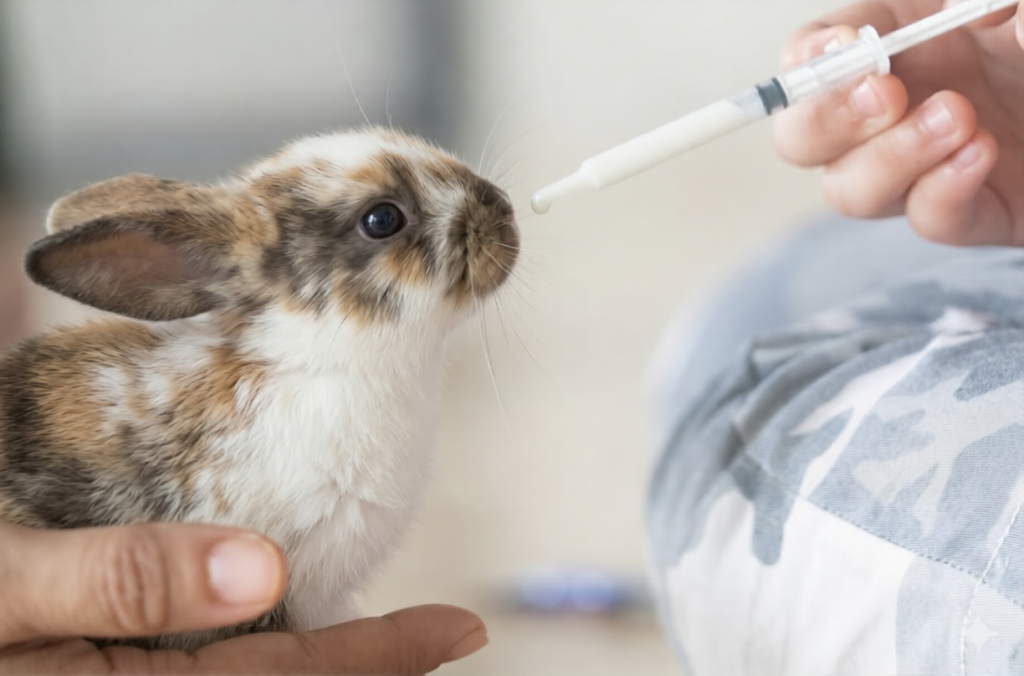
If the grinding is caused by a physical blockage, force-feeding Critical Care can cause a stomach rupture. Always ensure your vet confirms the gut is clear before you begin syringe feeding. If the system is fully distended, you are dealing with a severe bacterial bloom or gastrointestinal bloat emergency.
Secondary System Crashes
Ignoring continuous painful grinding allows the underlying root cause to advance unchecked. If a heavy respiratory rate is also present, it means the pain is driving the rabbit into critical shock, requiring you to instantly triage heavy or fast breathing thresholds before moving the animal.
13. Frequently Asked Questions
Is rabbit teeth grinding always bad? No. Quiet, rhythmic grinding during relaxation or petting is a “tooth purr” and signals a very happy bunny.
What does a pain grind sound like? It is much louder than a purr—often described as a grating or crunching sound—and can be heard from several feet away.
Can my rabbit grind their teeth while sleeping? Yes, rabbits can “purr” in their sleep when they are particularly comfortable.
Why is my rabbit grinding and pressing their belly to the floor? This is a classic sign of gas or GI Stasis; the rabbit is trying to find a position that relieves internal pressure. Consult a vet urgently.
Why is my rabbit grinding its teeth and refusing to move?
When grinding is paired with a total lack of movement, it indicates the rabbit has shifted from low-level pain into advanced exhaustion. This represents a lethargic or completely unresponsive crisis that demands emergency veterinary care.
14. Conclusion
Navigating these signals requires the speed of a first responder and the precision of a researcher. Because conditions like GI Stasis can turn fatal within a single afternoon, there is no “wait and see” period for a rabbit that has stopped eating. Stay vigilant, trust the auditory cues, and never ignore the silence of an empty food bowl. When in doubt, seek the experts at VCA Hospitals or your local clinic immediately.
Medical & Veterinary Disclaimer: Bunnyowners.com is an informational resource for rabbit owners and enthusiasts. We are not veterinarians. The content on this website is for educational purposes only and is not a substitute for professional veterinary advice, diagnosis, or treatment. Always consult a qualified veterinarian with any questions or concerns regarding your pet’s health, medical conditions, diet, or overall care. If you have concerns about your rabbit’s health, it’s always best to reach out to a veterinarian rather than relying solely on information found online.