

Veterinary & Affiliate Disclaimer: Bunnyowners.com shares educational rabbit care resources, not professional veterinary advice. Always consult a qualified veterinarian regarding your rabbit’s medical, dietary, or behavioral needs. This post may also contain affiliate links; as an Amazon Associate and affiliate partner, we earn from qualifying purchases at zero extra cost to you.
Rabbits are deeply expressive animals, but they communicate using a completely distinct set of behaviors than dogs or cats. When owners ask how rabbits communicate, they are often searching for a way to translate what their pet is trying to tell them. Because these sensitive prey animals treat vulnerability like a state secret out of survival instinct, learning their non-vocal language is the single best way to figure out what’s actually going on in that fluffy head of theirs. It helps you identify early signs of stress. Most importantly, it builds lasting trust.
Learning how rabbits communicate relies on combining visual postures, ear positioning, scent cues, and subtle behaviors. Rabbits talk without words. They use forward ears for curiosity. Intense thumping broadcasts warnings through ground vibrations, while soft tooth purring signals safety and affection. These distinct communication channels, paired with chemical signals like “chinning,” provide a clear conversation that allows owners to read their bunny’s emotional state with absolute certainty.
To help you accurately interpret your pet’s behavioral cues, this comprehensive guide balances foundational data from my dedicated rabbit behavior hub with a breakdown of how rabbits speak, ranging from high-intensity visual displays to the acoustic, tactile, and chemical signals they use to confidently manage their space. Think of it as your official translation manual for finally decoding exactly what that judgmental nose twitch actually means.
1. The Core Channels of Rabbit Communication
Because wild rabbits are constantly hunted by predators, their evolutionary survival strategy relies heavily on silent communication methods and visual signaling to avoid drawing attention. It’s a system designed to treat vulnerability like a state secret.
Making loud sounds in the wild is a death sentence. It draws immediate attention. This is why domestic rabbits, like their wild cousins, have evolved a deeply sophisticated, multi-channel approach to broadcasting signals, a system summarized visually in my Comprehensive Rabbit Behavioral Signaling Framework (Figure 1).
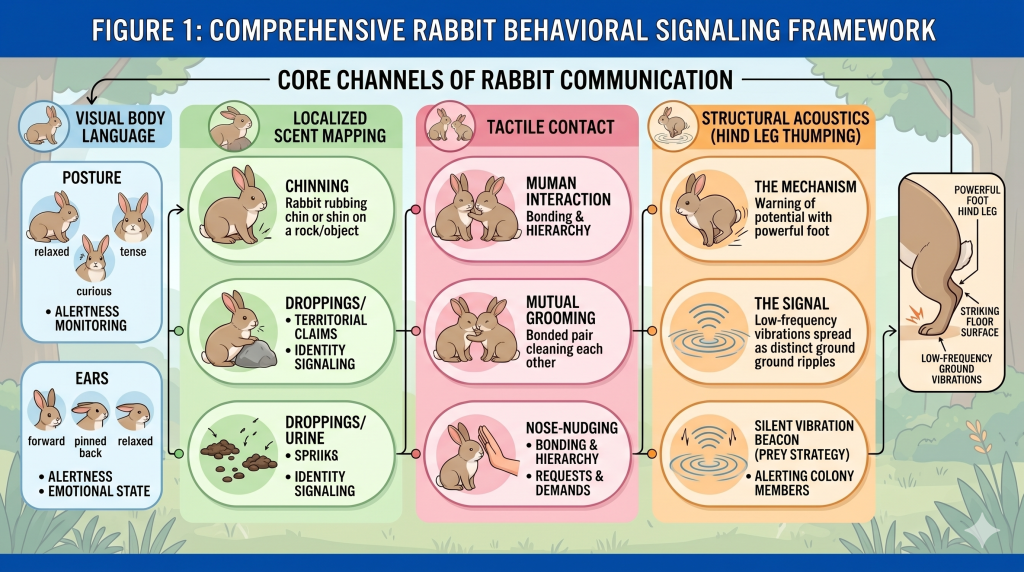
The Structural Earthquake: Hind Leg Thumping
Domestic rabbits communicate primarily through a precise mix of fine points in subtle visual body language and localized scent mapping (like ‘chinning’). They also rely heavily on direct tactile contact. We see these dynamics play out in everything from ear pivots to excited loops around your ankles.
While the remaining sections of this guide will break down exactly how to translate those visual, scent, and tactile signals, let’s first look at their most unique warning system. Rabbits are not limited to line-of-sight displays. They also utilize sophisticated structural acoustics.
When a rabbit thumps their powerful hind leg, a mechanism shown with precise visual detail in Figure 1, they are not simply throwing a fluffy tantrum over a late breakfast. They are releasing low-frequency vibrations designed to travel efficiently through the ground.
This action creates a clear, localized ‘earthquake’ that launches low-frequency ripples, detailed under ‘The Signal’ above. These ripples act as a silent alarm system. It allows bunnies to warn nearby colony members of a potential threat before it ever appears.
2. Reading Rabbit Ear Positions
A rabbit’s ears act as highly sensitive, fur-covered radar dishes, capable of swiveling 270 degrees to monitor their environment for both predators and the crinkle of a treat bag. The direction, angle, and tension of those ears serve as a primary indicator of their emotional state.
Table 1: Visual Guide to Rabbit Ear Postures and Meanings
| Ear Position | Physical Orientation | Associated Emotional State |
| Upright & Forward | Ears stand straight up, openings facing directly forward. | Active curiosity, high alertness, or environmental scanning. |
| Relaxed & Outward | Ears rest gently over the back, pointing slightly outward. | Calm baseline, resting comfort, and environmental security. |
| Pinned Flat | Ears pressed tightly down along the spine; body is tense. | Defensive aggression, anger, or an acute stress response. |
| The Independent Pivot | One ear points forward while the other swivels backward. | Split awareness; monitoring two distinct environmental zones. |
Breed Specifics: Lop-Eared Rabbits
According to behavioral archives on rabbit anatomy, even lop-eared breeds with limited muscle mobility will rigidly swing the base of their ears upward and outward when expressing irritation or defense.
3. Rabbit Facial Expressions and Eye Signals
When evaluating a rabbit’s expressions, owners frequently focus on large body movements while missing the critical, localized stress metrics displayed across the muzzle and eyes.
A happy, resting rabbit will keep their eyes partially closed or half-mast, looking like they just finished a massive plate of kale and are ready for a nap. They will show smooth facial muscles and relaxed, loose whiskers that droop slightly along the cheeks.
However, when a rabbit faces sudden stress or feels cornered, their eyes will dilate widely.
Acute Panic Signals
In moments of acute panic, a rabbit will expose their nictitating membrane, commonly known as the “third eyelid.” Specialized veterinary welfare guides on rabbit body language note that seeing the whites of a rabbit’s eyes or an exposed third eyelid is an explicit indicator of distress.
This visual tension is paired with whisker alignment; highly alert or investigating rabbits push their whiskers tightly forward, fanning them out to read physical air currents, while a terrified rabbit will freeze their nose twitch entirely to avoid detection.
4. Decoding Rabbit Sounds and Vocalizations

Rabbits may be quiet, but they are not entirely silent. Because their vocalizations are notoriously soft, you usually have to be right in their personal space to accurately hear and interpret their auditory cues.
Table 2: Deciphering Rabbit Vocalizations and Auditory Cues
| Sound / Action | Interpretation | Underlying Motivation |
| Soft Tooth Purring | Contentment and security | Enjoying head rubs or relaxing near a trusted companion. |
| Honking or Buzzing | Excitement / Courtship | Anticipating a favorite food or performing an affection dance. |
| Defensive Grunting | Immediate warning | Expressing territorial anger or severe irritation regarding handling. |
| Loud Tooth Grinding | Severe physical pain | Sign of acute internal distress or gastrointestinal complications. |
As outlined by clinical rabbit behavior and health diagnostics, harsh, rhythmic tooth grinding must never be confused with the gentle buzz of soft tooth purring. Loud grinding is a blaring medical warning sign, often accompanied by a rigid, hunched posture.
Pain and Emergency Calls
Conversely, the highest-intensity vocalization is the emergency scream—a piercing sound you hopefully never have to hear, as it signals catastrophic physical trauma or absolute terror and requires an immediate trip to the vet.
5. Scent Marking and Chemical Communication
Rabbits live in a rich sensory landscape dominated by olfactory tracking. They communicate environmental ownership, security, and social status by leaving localized chemical signatures across their territory.
Olfactory Ownership: Chinning and Territory
The most common iteration of this language is “chinning.” Rabbits possess highly active scent glands directly beneath their jawline.
When a rabbit rubs their chin against a table leg, a cardboard maze, or your bare ankle, they drop undetectable pheromones. In the rabbit world, this is the functional equivalent of planting a flag and declaring, “This is mine now.”
Dedicated environmental enrichment studies for rabbits highlight that chinning is a highly constructive behavior used to map out safe boundaries.
Territorial Dropping Tactics
Beyond chin rubs, unaltered rabbits use urine spraying and scattered, hard-packed droppings to establish territorial lines. While standard litter box habits show domestic comfort, a sudden line of scattered pellets across a doorway is a clear chemical broadcast stating that the space has officially been claimed.
6. Communicating with Humans vs. Other Rabbits
Rabbits vary their communication style heavily based on whether they are interacting with their human caretakers or a bonded partner.
When trying to get your attention or demand food, a rabbit will use deliberate physical contact. They will push their nose hard against your hand—a behavior explored deeply in my guide on why rabbits nudge you. Sometimes they pull gently at your pant legs. Other times, they complete tight, excited loops around your ankles.
If they want space, they will communicate it cleanly by:
- Using their head to push your hand away
- Taking a deliberate step backward
- Executing a definitive, sassy backward tail flick as they hop out of reach
Bonding and Hierarchy: Inter-Rabbit Communication
Between fellow rabbits, communication is deeply rooted in hierarchical ranking. A dominant bunny will approach a submissive partner and lower their chin firmly to the carpet, commanding a grooming session.
Table 3: Hierarchical and Social Bonding Signals Between Rabbits
| Social Behavior | Visual Presentation | Meaning & Hierarchy Status |
| Dominance Request | Lowering the chin firmly to the floor in front of another rabbit. | Demanding to be groomed; establishes or tests dominant rank. |
| Mutual Grooming | Taking turns gently licking each other’s heads and ears. | Deep social acceptance, harmony, and relationship equality. |
| Rank Challenging | Short, sudden chasing loops or mounting from behind. | Establishing dominance and finalizing the social hierarchy. |
Watching my resident rabbits, Mocha and Chino, makes it abundantly clear how these partner dynamics play out. As captured in the behavioral chart above, taking turns washing each other is a definitive sign of social harmony.
Mocha, who is naturally more assertive, frequently uses dominant head-lowering to demand instant grooming, the rabbit equivalent of “massage me, peasant”, while Chino communicates his social acceptance through cooperative, gentle grooming sessions.
Mutual grooming and side-by-side resting indicate social equality and mutual trust. For a deeper look into how these relational bonds develop over time, check out my definitive guide to rabbit behavior, which details how prey species select safe companions.
7. Misunderstood Rabbit Behaviors Explained

Because rabbit communication is incredibly subtle, owners frequently interpret prey-defense mechanisms as lifestyle quirks or negative attitudes. A classic example is staring. New owners often feel intimidated when a rabbit locks eyes with them from across the room without moving an inch.
In reality, because a rabbit’s eyes are set high and wide on their skull to provide a nearly 360-degree field of vision, they have to look at you sideways to track motion and calculate depth perception. They aren’t plotting against you; they are simply gathering data to verify that your movements are safe.
Another common misunderstanding is phantom digging. When a rabbit hops onto your lap or a favorite blanket and begins lightly scratching at the material with their front paws, owners often view it as a destructive habit.
Phantom Digging Demands
However, this is actually a distinct communicative command where your rabbit is asking for interactive attention or outright demanding that you move your hand.
Watching Mocha and Chino highlights exactly how individual temperaments shape these misunderstanding loops.
Mocha often uses rapid phantom digging on blankets as a direct demand for immediate attention (usually involving treats), while Chino communicates his boundary limits by silently staring from a distance like a tiny, judgmental statue when he prefers to monitor his surroundings undisturbed.
Mutual grooming and side-by-side resting indicate social equality and mutual trust. For a deeper look into how these relational bonds develop over time, check out my comprehensive breakdown on rabbit body language and bonding.
8. How Rabbits Show Pain and Illness
Because wild rabbits that show vulnerability are quickly targeted by predators, domestic rabbits instinctively hide physical illness until it reaches an advanced stage.
As a result, recognizing their unique pain signals is an essential diagnostic tool for proactive caretakers.
Table 4: Identifying Rabbit Illness and Pain Indicators
| Behavioral Shift | Physical Presentation | Immediate Care Action |
| The Hunched Sit | Body tightly compressed; nose pressed to floor; eyes glazed. | Check belly tension; monitor for gastrointestinal stasis. |
| Harsh Tooth Clicking | Loud, audible jaw grinding; body is rigid and tense. | Provide a warm resting surface; contact your veterinarian. |
| Routine Withdrawal | Abruptly hiding in isolated corners; absolute food refusal. | Treat as an emergency; check baseline temperature and droppings. |
Emergency Withdrawal Indicators
According to clinical health guidelines for small mammals, any sudden departure from normal patterns of behavior—such as a naturally outgoing bunny suddenly becoming withdrawn or refusing to leave a dark closet—is a silent call for an urgent medical evaluation.
9. How to Respond to Your Rabbit’s Language
To build a secure bond with your pet, you must adjust your daily habits to respect their communicative boundaries.
First, approach them on their level. Modern housing and lifestyle guidelines for rabbits emphasize that looming over a rabbit from a standing position makes you look less like a loving owner and more like a hungry hawk. Spend time sitting flat on the floor, allowing your rabbit to initiate the interaction on their terms.
Respecting Boundaries and Refusals
Second, respect their right to say no. If you reach down to pet your rabbit and they pin their ears back or turn their tail toward you, honor that communication by withdrawing your hand.
Allowing your bunny to successfully set boundaries builds an immense sense of environmental safety. Counterintuitively, respecting their desire for space ultimately leads to more voluntary affection. You’ll see more energetic binkies. You’ll get more relaxed side-flops down the road.
Table 5: Actionable Checklist for Multi-Channel Communication
| Communication Goal | Owner Action | Why It Works |
| Establish Trust | Sit completely flat on the floor during early active hours. | Removes predatory height intimidation and allows voluntary contact. |
| De-escalate Fear | Mimic a soft tooth purr by lightly tapping your fingernails. | Uses familiar acoustic safety signals to lower baseline stress. |
| Respect Boundaries | Stop interaction immediately if they flick their tail or move away. | Validates their defensive language, preventing fear-based nipping. |
10. Frequently Asked Questions (FAQ)
Can rabbits understand human voices?
Rabbits recognize vocal inflections, pitch changes, and short, highly consistent words (like their names or a treat command) through routine association rather than literal linguistic processing.
Why does my rabbit thump when nothing is there?
Rabbits have highly acute hearing and incredible tactile sensitivity to floorboard vibrations. They often thump to sound an alarm for low-frequency noises—like distant outdoor footsteps or heavy garage doors—that our human ears completely miss.
How do rabbits communicate dominance?
Dominance is communicated through mounting behaviors, brief territorial chases, and “dominance grooming requests,” where the top rabbit places their jaw firmly against the carpet to force the submissive rabbit to lick them. For more details, consult guides on establishing bunny bonds
.
What does a rabbit mean when they flick their tail at you?
A quick, backward tail flick while hopping away is an explicit expression of mild irritation, disapproval, or annoyance regarding a recent interaction, an unwanted handling attempt, or a disruption to their schedule.
Do bonded rabbits communicate differently than single rabbits?
Yes. Bonded pairs rely heavily on quiet structural mirroring and synchronized movement to manage their space, rather than relying on the high-intensity visual displays or loud warning thumps frequently used by solo rabbits.
Conclusion
Reading a rabbit’s emotional state requires focusing on the specific indicators of prey-animal behavior rather than looking for the obvious signals we expect from confident predators like dogs or cats. A rabbit’s well-being is best measured by consistency: a regular daily routine, a steady appetite, and a willingness to explore their surroundings without fear.
By keeping track of small details like ear posture, nose rhythm, and interaction preferences, you can easily verify your rabbit’s true emotional state and build a lifetime of trust.
Medical & Veterinary Disclaimer: Bunnyowners.com is an informational resource for rabbit owners and enthusiasts. We are not veterinarians. The content on this website is for educational purposes only and is not a substitute for professional veterinary advice, diagnosis, or treatment. Always consult a qualified veterinarian with any questions or concerns regarding your pet’s health, medical conditions, diet, or overall care. If you have concerns about your rabbit’s health, it’s always best to reach out to a veterinarian rather than relying solely on information found online.