

Veterinary & Affiliate Disclaimer: Bunnyowners.com shares educational rabbit care resources, not professional veterinary advice. Always consult a qualified veterinarian regarding your rabbit’s medical, dietary, or behavioral needs. This post may also contain affiliate links; as an Amazon Associate and affiliate partner, we earn from qualifying purchases at zero extra cost to you.
Finding a sudden minefield of cocoa puffs across your freshly vacuumed rug is a fast way to ruin your morning—especially when your rabbit usually has pristine bathroom habits. It feels entirely out of character, and frankly, a bit like a tiny, silent protest. If you are left wondering why your civilized house pet has suddenly started data-mapping your floors with fecal markers, the root cause typically maps back to a specific set of environmental, hormonal, and instinctual shifts.
A rabbit will suddenly start pooping everywhere to data-map their environment, a behavioral shift typically triggered by instinctual territorial marking, adolescent hormonal surges, or localized environmental stress. If your civilized house pet is bypassing their tray, it usually points to an unoptimized litter box setup, incomplete space training, or a recent change in your living room layout. Restoring domestic order requires an immediate veterinary check to rule out underlying medical issues, followed by an enzymatic cleanup and a temporary restriction of their free-roam privileges.
To stop the scatter-pooping, you need to clean up past accidents with dedicated enzymatic cleaners, temporarily shrink their roaming boundary to reset their habits, optimize the physical layout of their litter tray with easy entry points and fresh hay, and rule out any clinical discomfort. Drawing from my broader collection of rabbit behavior articles, this troubleshooting field guide breaks down the biological communication behind natural lagomorph bathroom habits, exposes common owner pitfalls, highlights critical veterinary warning signs, and provides a clear, evidence-based framework to restore your home’s boundaries permanently.
1. Is It Normal for Rabbits to Poop Everywhere?
Before staging a massive behavioral intervention for your pet, it helps to look at basic rabbit biology through a researcher’s lens. Rabbits naturally drop a few stray fecal pellets as they go about their day—think of it as casual littering. Out in the wild, these pellets serve as a highly sophisticated, scented communication grid. They tell neighboring rabbits exactly who owns a patch of grass, what their social standing is, and whether the perimeter is secure.
That said, as data-driven owners, we have to draw a clear line between casual stray pellets, intentional boundary marking, and a complete breakdown of litter training:
- Healthy Fecal Pellets: Round, dry, odorless spheres of compressed fiber that are easy to sweep up. This is the standard currency left behind during behavioral marking.
- Cecotropes: Pungent, sticky clusters that look like tiny blackberries. Rabbits typically consume these directly from the anus for vital nutrients, as detailed in VCA Animal Hospitals’ clinical overview of rabbit nutrition. If you are finding these abandoned on the carpet, your rabbit’s diet is likely too rich, or they are dealing with a physical limitation that stops them from reaching their hindquarters.
- Problem Stool: Mushy, unformed puddles or watery liquid diarrhea constitute a true veterinary emergency rather than a behavioral puzzle.
Table 1: Quick Reference Guide to Rabbit Droppings
| Dropping Type | Physical Appearance | Action Required |
| Healthy Fecal Pellets | Round, dry, firm, uniform size | Sweep up; normal biology |
| Cecotropes | Sticky, dark, blackberry-shaped clusters | Optimize diet if left uneaten |
| Problem Stool | Mushy, watery, or unformed puddles | Immediate veterinary intervention |
Most online guides fail to mention that a few stray droppings outside the box are entirely normal, even for a gold-star house rabbit. According to the House Rabbit Society’s guide to natural litter routines, working with these natural instincts is part of the process, and expecting absolute perfection will only break your heart. But when you start finding heavy clusters or deliberate lines of pellets tracing your baseboards, you are looking at a clear behavioral shift.
2. Why Is My Rabbit Pooping Everywhere?
Rabbits are remarkably efficient creatures who rarely waste energy; every single pellet dropped outside the box has a specific, calculated intent behind it.
Territorial Marking
Rabbits rely on feces to draw boundary lines and make their environment feel secure. If you have recently moved to a new apartment, rearranged the living room layout, invited guests over, or introduced a new pet, your rabbit will often scatter droppings to reassert ownership. This localized marking typically clusters along room thresholds, baseboards, or right next to their favorite resting spots.
Table 2: Territorial Changes and Environmental Impacts
| Environmental Trigger | Why It Causes Scatter-Pooping | Primary Target Areas |
| Rearranged or New Furniture | Removes familiar scent profiles | Sofa edges, table legs |
| Moving to a New Home | Total loss of established territory | Room perimeters, doorways |
| Introduction of a New Pet | Scent competition and dominance | Shared gates, neutral zones |
Incomplete Litter Training & Space Management
Giving a rabbit free-roam privileges too early is an exercise in demographic optimism. If an adolescent rabbit is granted an entire living room before their habits are locked down, they will simply use whichever corner is closest when the urge strikes. Rabbits learn boundaries best when their territory expands in stages. Reviewing the Rabbit Welfare Association & Fund’s space guidelines emphasizes that over-allocating unsupervised square footage before habits are established naturally results in territory marking.
Hormonal Behavior
If your rabbit is between 3 and 6 months old and suddenly treats your rug like a public restroom, hormones have officially entered the chat. Reaching maturity dramatically intensifies the urge to mark territory. While both sexes display this behavior, unneutered males are particularly famous for sudden, aggressive scatter-pooping campaigns to show everyone they have grown up.
Stress and Anxiety Mechanisms
When a rabbit feels anxious—whether from loud traffic, nearby construction, travel, or a shift in your work schedule—they surround themselves with their own scent to build a protective psychological perimeter. A stressed rabbit marks because smelling their own signature makes them feel safe in an unpredictable space. This specific defensive reaction is noted in the RSPCA’s analysis of rabbit stress indicators, which tracks how rapid environmental changes alter everyday toileting choices.
The Scent Mechanics of Beds and Couches
Why do soft, elevated surfaces like your bed or the sofa seem to attract the most accidents? It comes down to scent dominance. Couches and beds are high-profile social spaces that are absolutely saturated with your distinct human scent. When your rabbit hops up there, they experience an overwhelming instinct to mix their scent profile with yours to claim the space and reinforce their bond with you.
When observing my own bonded pair, Mocha and Chino, this behavior was distinct early on. If they managed to sneak onto a freshly washed blanket on the sofa, a handful of pellets immediately followed. They weren’t being bad; they were just updating the household’s scent registry. Keeping them off elevated furniture temporarily and using waterproof covers is the quickest way to break this association.
Bonding and Hierarchy Disputes
When introducing a new companion animal or navigating a temporary shift in a bonded pair’s dynamic, the shared living space becomes a high-stakes geopolitical zone. This tension triggers an immediate escalation of scattered pellets as both rabbits attempt to out-mark and out-claim each other’s boundaries. The behavior typically normalizes once the social hierarchy stabilizes.
Medical Causes
Physical discomfort will break even the best bathroom habits. Chronic joint stiffness or spinal issues can make hopping over the high wall of a standard litter box incredibly painful. For alternative options, look to Arizona Exotic Animal Hospital’s guide on senior rabbit care, which details how to build flat, low-threshold latrine zones for rabbits experiencing mobility limits.
3. How to Stop a Rabbit From Pooping Everywhere
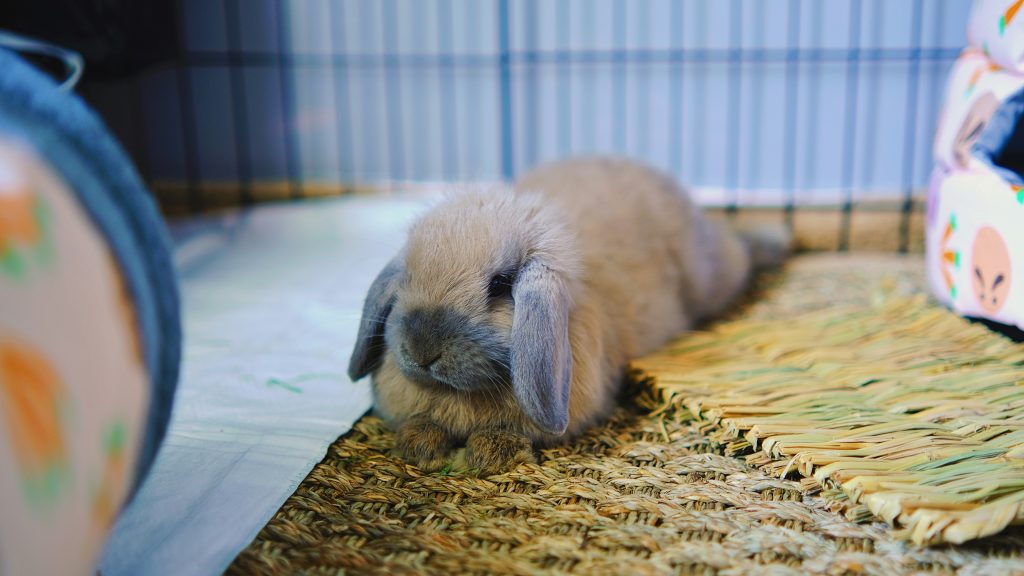
Correcting a behavioral regression requires consistent, systematic environmental changes rather than hoping your rabbit simply changes their mind.
Clean Accidents Thoroughly
Standard household surface cleaners will not cut it here. Cleaning products that contain ammonia actually mimic the chemical signature of urine to a rabbit, which invites them right back to the same spot to mark over it. You need to use a dedicated enzymatic cleaner to fully break down the underlying organic scent proteins.
The “Small Space Reset” Method
If your rabbit’s habits have completely fallen apart, it is time to hit the reset button by reducing their freedom. Move them back into a spacious exercise pen (x-pen) equipped with their box, food, and water. Restricting their physical environment rewires their spatial awareness, forcing them to separate their immediate living space from their bathroom zone. Once they use the box consistently for several consecutive days, you can slowly expand their floor space.
Optimize the Litter Box Setup
Rabbits are prey animals that naturally prefer to eat and eliminate simultaneously to save time and stay safe. Do yourself a favor and skip those tiny corner boxes sold in pet stores; a rabbit needs a large, low-entry tray—like a standard cat litter pan—to feel comfortable. Mount a generous hay rack directly over the box so they can munch on fresh timothy hay while they use the facilities. If your home has multiple levels, make sure there is at least one station per floor.
Table 3: Litter Box Optimization Checklist
| Component | Common Issue | Proper Setup Solution |
| Box Size | Too small or cramped | Large cat litter pan with low entry |
| Box Quantity | One box for a multi-level home | At least one box per floor/room |
| Hay Placement | Separated from the latrine | Mounted directly over or inside the box |
Positive Reinforcement Systems
Rabbits are highly sensitive animals that do not understand discipline. Scolding them, clapping, or pointing at an accident will only break their trust, raise their anxiety levels, and inevitably trigger more stress-related marking. Focus on real-time rewards instead. The second you see your rabbit hop into their box, reward them immediately with a pinch of fresh herbs or a small, safe treat to cement the positive association.
Spay or Neuter Your Rabbit
If you are working with an intact rabbit, you are essentially fighting a losing battle against raw biology. Consulting PDSA’s comprehensive guide to rabbit spaying and castration shows how dramatically these minor surgeries reduce territorial urine spraying and instinctive pellet scattering.
On top of the behavioral benefits, the Association of Exotic Mammal Veterinarians’ official rabbit health guide underscores that fixing your rabbit prevents severe reproductive cancers while directly eliminating the hormonal frustration that fuels aggressive territoriality.
4. Common Owner Mistakes
When troubleshooting a messy floor, make sure you aren’t accidentally encouraging the very behavior you are trying to fix by making one of these classic user errors.
Using the Wrong (or Dangerous) Litter
Grabbing a standard bag of cat litter is a frequent and dangerous error. Traditional clumping clay litters can cause fatal blockages inside a rabbit’s digestive tract if ingested during grooming. Similarly, untreated pine or cedar shavings release airborne phenols that can cause respiratory irritation over time. If a rabbit dislikes the physical texture or scent of their substrate, they will skip the box entirely in favor of your soft rug. Stick to paper-based pellets or kiln-dried alternatives. For a deeper look at overarching animal safety, checking the ASPCA’s guidelines on small pet care outlines clean baseline parameters for safe bedding choices.
Table 4: Safe vs. Hazardous Substrates for Rabbit Litter Boxes
| Substrate Material | Safety Status | Health Risks or Benefits |
| Recycled Paper Pellets | Safe | High absorbency, completely non-toxic |
| Kiln-Dried Pine | Safe | Phenols removed during processing; safe option |
| Clumping Clay Cat Litter | Hazardous | Fatal gastrointestinal blockages if swallowed |
| Untreated Cedar Shavings | Hazardous | Toxic phenols can cause chronic liver damage |
The “Too Clean” vs. “Too Dirty” Dilemma
Rabbits like order. If their litter box becomes deeply soiled or waterlogged, they will refuse to stand in it and will start dropping pellets right along the outer rim instead. On the flip side, scrubbing the box down daily with harsh chemical bleaches completely strips away their comforting home scent markers, which panics the rabbit and prompts them to start re-marking your floor from scratch. The ideal routine is a daily spot-scoop of wet areas combined with a simple white-vinegar wipe down once a week.
Sudden Brand Switches
Rabbits thrive on predictability and are deeply suspicious of sudden shifts in their environment. If you run out of their usual paper pellets and abruptly dump a completely different brand of wood pellets into their tray, your rabbit might treat the box like an alien object. Always transition to a new litter brand slowly by mixing the two varieties together over the course of a week.
The “Cat Approach” to Discipline
Trying to discipline a rabbit using methods meant for a predatory pet will always backfire. Swishing a rolled-up magazine or making loud noises doesn’t connect to their bathroom choices at all. It simply teaches them that you are unpredictable and dangerous, creating a cycle of fear that directly results in more defensive, stress-induced scatter-pooping across your home.
5. Why Fully Trained Rabbits Leave “Maintenance Poops”
As you work through retraining, it is vital to keep your expectations grounded in actual rabbit behavior. The concept of a 100% perfectly house-trained rabbit is largely an online myth.
Even highly trained rabbits will leave a casual dropping here and there. Think of these as “maintenance poops.” They are dropped completely by accident during a high-energy binky, or left behind as a low-level territorial reminder near major doorways. Even after years of consistent routines, Mocha and Chino will occasionally leave a stray pellet near the doorway of their room. This isn’t a failure in training; it is simply the reality of living with an animal whose primary language is scent.
6. Critical Vet Warning Signs
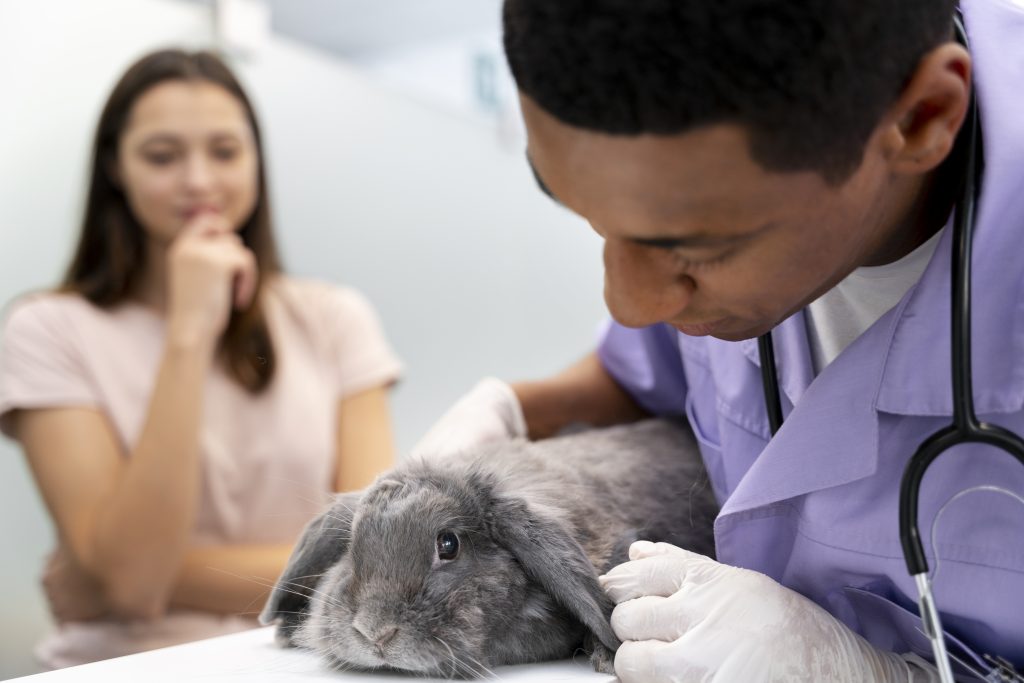
While a messy floor is an annoying housekeeping chore, a sudden halt in your rabbit’s poop production is a medical crisis. While you can patiently troubleshoot behavioral issues at home, you need to head to an exotic vet immediately if you notice your rabbit has stopped passing waste.
A sudden halt in digestion can indicate a life-threatening crisis, which is outlined clearly in VCA Animal Hospitals’ clinical overview of gastrointestinal stasis. If your rabbit is producing no pellets, refuses food, or sits in a hunched position, their gut may be entirely immobile.
It’s also worth noting that if your rabbit swallows dangerous clay litter, carpet fibers, or plastics, it can induce a physical obstruction. You can read more about these acute structural emergencies in Lafeber Vet’s diagnostic guide to gastrointestinal blockages, which stresses the importance of rapid veterinary intervention when an absolute blockage cuts off internal blood flow.
7. Frequently Asked Questions
Why does my rabbit poop right next to the litter box instead of inside it?
This usually means the box itself is too small or the entry point is too high. Your rabbit might willingly step their front paws in, but if their rear end hangs over the lip, the pellets will land outside. In older rabbits, it can also point to early spinal stiffness that makes stepping over high barriers uncomfortable.
Why do they scatter droppings immediately after I clean the cage?
When you completely sanitize their living area, you erase their familiar scent map. Dropping a fresh line of pellets is their way of quickly reclaiming the blank canvas so their territory feels safe and recognizable again.
Can a rabbit poop while running or binkying out of pure excitement?
Yes. When a rabbit experiences a massive burst of adrenaline or pure joy during a sprint, their physical control takes a back seat. A few pellets dropped during a joyful mid-air twist are entirely accidental.
How many individual litter boxes should I set up?
The baseline standard is one primary box inside their home enclosure, plus at least one additional box in every free-roam room they have permission to explore.
Is behavioral regression common as a rabbit reaches senior age?
Yes. Senior rabbits often experience joint stiffness or cognitive decline. If an aging rabbit suddenly loses their habits, have an exotic veterinarian check them for hidden joint pain before assuming it is a typical quirk of rabbit behavior.
8. Conclusion
When your rabbit begins treating your entire home like an open-air bathroom, stepping back to analyze the environment from a prey animal’s perspective is the best path forward. The vast majority of sudden regressions map back to territorial anxiety, shifting hormones, or a lack of clarity around their boundaries.
By committing to thorough enzymatic cleanups, relying on a temporary space reset to rebuild their instincts, and fixing any issues with their litter tray setup, you can typically get their habits back on track within a few weeks. Maintain your patience and remember that a few stray pellets are part of the package when sharing your life with a rabbit. Keep an eye out for any genuine medical red flags, and use calm, structured environmental changes rather than frustration to guide them back to the box.
Medical & Veterinary Disclaimer: Bunnyowners.com is an informational resource for rabbit owners and enthusiasts. We are not veterinarians. The content on this website is for educational purposes only and is not a substitute for professional veterinary advice, diagnosis, or treatment. Always consult a qualified veterinarian with any questions or concerns regarding your pet’s health, medical conditions, diet, or overall care. If you have concerns about your rabbit’s health, it’s always best to reach out to a veterinarian rather than relying solely on information found online.