
Veterinary & Affiliate Disclaimer: Bunnyowners.com shares educational rabbit care resources, not professional veterinary advice. Always consult a qualified veterinarian regarding your rabbit’s medical, dietary, or behavioral needs. This post may also contain affiliate links; as an Amazon Associate and affiliate partner, we earn from qualifying purchases at zero extra cost to you.
If your rabbit has ever hopped up to lick your hands, face, or clothes, you are probably wondering exactly what this charming—and slightly damp—behavior actually means. Does it mean they love you, are they trying to groom you, or do they just like the taste of your skin? While dog kisses are a widely understood sign of affection, a rabbit’s decision to lick you is a highly specialized biological instinct rooted in wild survival strategies. To truly understand why your bunny is licking you, we have to look past the immediate cuteness and unpack the complex social codes of rabbit culture.
Table of Contents hide
The good news is that you haven’t just been selected as a casual salt lick. By exploring the underlying evolutionary science, warren hierarchies, and sensory triggers, we can decode exactly what your pet is trying to communicate when they choose to groom you. From understanding the delicate line between a kiss and a love nip to discovering alternative ways your bunny shows devotion, mapping this unique vocabulary will completely transform how you interact with your companion and navigate the wider world of rabbit behavior.
1. The Science Behind Allogrooming
In the wild, the European rabbit (Oryctolagus cuniculus) survives by operating within highly organized, subterranean communities. Within these dense social networks, allogrooming—the biological term for animals grooming members of their own species—serves as the primary currency for maintaining group harmony and peace, a fascinating dynamic documented extensively in the Journal of the American Association for Laboratory Animal Science.
This behavior is far more than a simple hygiene routine. Clinical observations of bonded pairs demonstrate that mutual grooming sessions significantly reduce cortisol (the primary stress hormone) and actively lower the heart rates of both participants, stabilizing core physiologic parameters inside an intensely territorial species.
When your domestic rabbit hops over and initiates a meticulous grooming session on your hand or sleeve, they are effectively bridging a massive species gap. They are utilizing their most sacred ancestral bonding ritual to formally declare that you are no longer viewed as a terrifying, giant mammalian predator, but rather as a permanent, deeply trusted resident of their human-sized warren.
2. 5 Common Reasons Your Rabbit Licks You
Because rabbits are low on the global food chain, every instinct tells them to stay alert. Lowering their head to lick a human requires them to take their eyes off their surroundings, placing them in a highly vulnerable position. When they groom you, they are offering the ultimate compliment: “I am safe enough in your presence to lower my guard.”
Returning the Favor (Reciprocal Grooming)
Rabbit relationships are built on a system of mutual benefit. If you spend fifteen minutes offering long, luxurious strokes over their forehead and behind their ears, their instincts will frequently compel them to return a few quick licks. Think of it as a polite, automated “thank you” text encoded directly into their DNA.
Showing Dominance or Submission
Here is where rabbit social dynamics get highly nuanced. Licking isn’t always an act of pure, humble submission; often, it is a complex negotiation of social status. To see how these communication channels operate across their entire daily routine, check out my definitive guide to rabbit behavior.
- Submissive Licking: A lower-ranking rabbit will groom your feet, ankles, or hands while keeping their head low to the ground, willingly acknowledging your status as the “Top Bun.”
- Dominance Licking: A dominant rabbit will condescend to offer you a couple of brief, kingly licks on your fingers, but will immediately stop, freeze, and forcefully ram their nose flat against the floor right under your hand.
Observational Case Study: This exact hierarchy play plays out constantly between my bonded personal rabbits, Mocha and Chino. Chino, who is naturally more submissive, will happily groom Mocha’s eyes and ears for twenty minutes while she sits entirely relaxed like royalty. If Mocha decides to return the favor, she will offer Chino exactly two quick licks on his forehead, and then instantly flatline her head against the floor. She isn’t being sweet; she is using those two token licks to demand that Chino immediately resume his submissive grooming duties. In the rabbit world, the true boss always receives the most licks.
Tasting Food Residue or Lotions
Rabbits lack hands, so they interact with their environment using their whiskers, incisors, and highly sensitive tongues. If you recently handled an apple, a banana, or a piece of kale, your rabbit isn’t necessarily grooming you—they are actively harvesting the sweet fruit sugars left behind on your fingers. Similarly, certain botanical hand lotions or scented soaps can mimic natural plant aromas, triggering a curious licking response.
Asking for Attention or Food
Rabbits are brilliant processors of cause and effect. If a rabbit learns that walking up to your foot and licking your ankle results in you waking up, petting them, or dropping a piece of fresh romaine lettuce, they will quickly adopt licking as a silent, highly effective alarm clock.
To help visualize these distinct motivations, we can look at how different drivers manifest in daily behavior.
Table 1: Main Reasons for Rabbit Licking
| Motivation Type | Primary Body Language Cue | Common Target Area | Intent |
| Bonding / Affection | Relaxed eyes, soft ears, low breathing | Hands, wrists, forearms | Reaffirming you as a trusted warren member. |
| Hierarchy / Status | Flattened chin, sudden freeze posture | Fingers, toes, forehead | Dictating social order or demanding return grooming. |
| Sensory / Culinary | Rapid sniffing, localized intensity | Tips of fingers, mouth area | Harvesting food residue or tasting sweet/scented lotions. |
| Resource Demands | Active nudging, persistent nipping | Ankles, elbows, clothing | Requesting immediate attention, treats, or fresh hay. |
3. Do Rabbits Lick People for Salt?
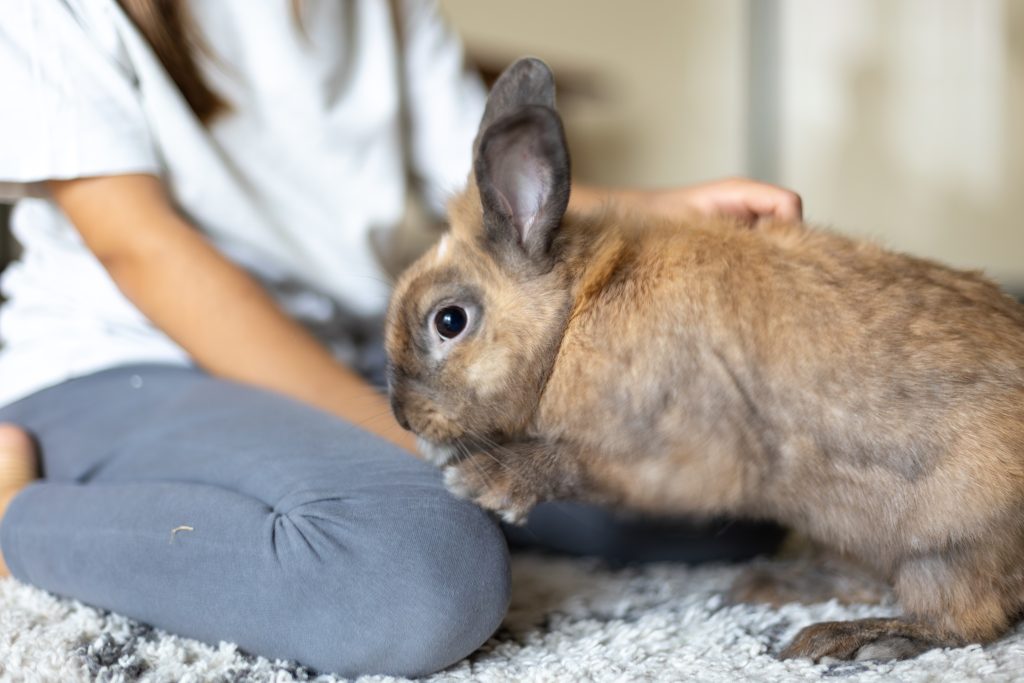
Open up almost any generic pet forum, and you will find well-meaning users claiming that rabbits only lick human skin because they are desperate for salt or suffering from a severe mineral deficiency. From a veterinary science perspective, this is a complete myth.
A healthy domestic rabbit consuming an optimal daily diet—consisting of 80-90% high-quality grass hay (like Timothy or Orchard grass), a measured ration of fortified pellets, and a handful of fresh leafy greens—receives 100% of their necessary micro-minerals and sodium. While the natural, microscopic saltiness of human sweat might act as a passing sensory novelty, it is never the primary driver behind sustained grooming behavior.
Because of this myth, many owners mistakenly buy commercial salt licks or mineral blocks for their rabbit’s enclosure. These blocks are not only entirely unnecessary, but they can also introduce dangerously high levels of calcium into your rabbit’s digestive tract. Because of the unique way rabbits metabolize calcium, excess amounts are excreted through their urinary tract, an anatomical quirk explained in depth by Veterinary Partner, which heavily correlates with the development of bladder sludge and painful kidney stones. Skip the salt block; your bunny’s diet is already complete.
To evaluate what your rabbit actually requires versus what these commercial products supply, consider the structural breakdown below.
Table 2: Rabbit Diet Needs vs. Mineral Block Risks
| Dietary Component | Ideal Daily Target Source | Biological Purpose | Consequence of Commercial Block Overuse |
| Sodium & Minerals | Fortified pellets, leafy greens | Electrolyte balance, cellular health | Excessive intake leading to systemic dehydration. |
| Calcium | Timothy/Orchard grass hay | Skeletal integrity, dental wear | Severe urinary tract sludge and painful kidney stones. |
| Hydration | Fresh, clean water bowl | Digestion, kidney flushing | Strain on renal filtration from filtering dense minerals. |
| Fiber | Unlimited long-stem grass hay | Gastrointestinal motility | None (Mineral blocks lack vital digestive fiber entirely). |
4. Why Rabbits Lick and Then Nip
A common source of frustration for rabbit owners is the behavioral whiplash of a blissful session of gentle, affectionate licking that abruptly ends with a sharp, unexpected pinch, often called a “love nip.” It’s easy to take this personally, but understanding the mechanics of lagomorph grooming changes the context entirely.
In a normal social grooming session between two rabbits, they don’t just use their tongues. To keep each other’s coats healthy, buns will frequently use their sharp front incisors to gently tug out mats, trapped debris, or loose, dead undercoat during a heavy seasonal molt, a vital care requirement noted on WabbitWiki. They are essentially performing a deep-tissue comb-through.
Observational Case Study: I watch this exact biological crossover happen regularly with Mocha and Chino during their seasonal coat changes. Mocha will fastidiously lick Chino’s shoulders to help remove his loose winter fluff, and when she encounters a stubborn tuft of loose fur, she will use her teeth to give it a firm tug. Chino will let out a soft, disgruntled grunt if she pulls too hard, which lets her know to soften her approach. When your rabbit applies this exact same intuitive grooming protocol to hairless human skin, however, there is no thick fur coat to absorb the impact. That helpful tug manifests on your bare skin as a painful nip. It’s an act of thorough, over-enthusiastic caretaking, not unprovoked malice.
If your rabbit nips you during a grooming session, avoid yelling or pushing them away, as this will damage their sense of safety. Instead, copy their natural communication style: emit a sharp, high-pitched “Ouch!” sound and gently pull your hand away for a few seconds. This mimics the exact feedback a fellow rabbit would provide, teaching them that human skin is far more delicate than a fur coat.
When interpreting these physical signals, it helps to distinguish a well-meaning grooming error from other types of oral communication.
Table 3: Differences Between Licks, Nips, and Bites
| Behavioral Action | Accompanying Posture | Intended Message | Proper Human Response |
| Gentle Licking | Flat, elongated body, soft breathing | “You are family, let me clean you.” | Continue petting softly to reinforce the bond. |
| Grooming Nip | Close proximity, follows active licks | “I am trying to extract a mat right here.” | High-pitched “Ouch!” to signal thin human skin. |
| Attention Nudge/Pinch | Shoving head up, erect ear posture | “Move your hand or give me my treat now.” | Ignore the push briefly so it doesn’t become a habit. |
| Aggressive Bite | Backward ears, lunging, bared teeth | “Back off immediately, I feel threatened.” | Freeze, retreat slowly, and reassess territorial stressors. |
5. Why Doesn’t My Rabbit Lick Me?
If your rabbit has never offered you a single tongue-kiss, please do not panic. A distinct lack of oral grooming does not mean your pet secretly dislikes you or views you as an enemy.
Just like humans, rabbits possess incredibly distinct individual personality profiles, which can be explored via general welfare registries like the House Rabbit Society. Some rabbits are verbose, highly physical social butterflies who will lick anything within arm’s reach. Others are more reserved, dignified introverts who express their deep devotion through entirely different behavioral markers.
If your rabbit doesn’t lick, look closely for these alternative signs of high trust, which carry the exact same psychological weight as a lick:
- The Side-Flop: Dropping completely flat onto their side or back right next to you, exposing their vulnerable belly.
- The Binky: Executing a sudden, joyful leap and mid-air twist in your immediate presence.
- The Nose Nudge: Hopping up to your hand and firmly bumping you with their nose, which is the universal rabbit signal for “I am here, please acknowledge me.”
- Pancaking: Melting completely flat against the floor right beside your chair, indicating total relaxation and security.
To better track these quiet signs of devotion, we can categorize how different personality types show affection.
Table 4: Other Ways Rabbits Show Trust
| Expression Category | Behavioral Action | Subtext / Hidden Meaning | Trust Equivalency |
| The Physical Socialite | Copious, daily allogrooming | “I am taking full responsibility for your hygiene.” | Equal to high-level colony acceptance. |
| The Quiet Companion | Low-profile loafing/pancaking nearby | “I trust you enough to entirely relax my guard.” | Equal to a steady, confident bond. |
| The Acrobat | Spontaneous binkies and room zoomies | “Your presence makes me completely safe and happy.” | Equal to high emotional joy. |
| The Subdued Introvert | Exposing the belly via full side-flops | “I know you will protect me from predators.” | Equal to maximum psychological security. |
6. When Is Licking a Sign of Illness or Stress?
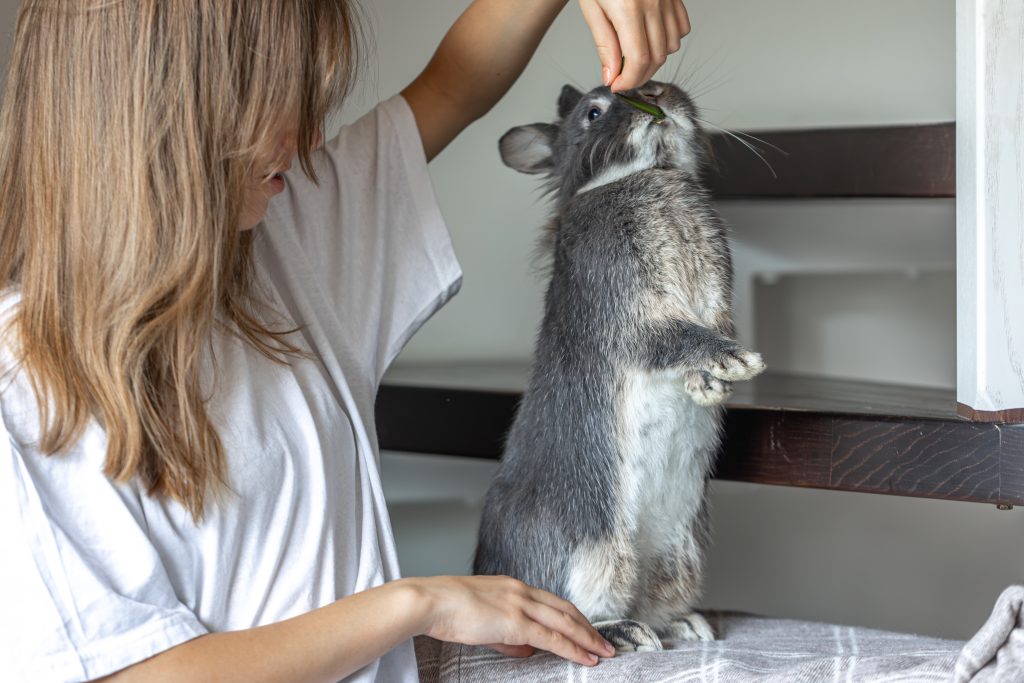
While licking is usually a wonderful sign of a happy, well-adjusted rabbit, there are times when it crosses the line from social behavior into a stereotypic or compulsive medical symptom.
If your rabbit transitions from licking you to frantically, obsessively licking inanimate objects—such as sofa cushions, synthetic carpets, blankets, or the metallic bars of their enclosure—for hours at a time, it is usually a sign of chronic boredom or environmental anxiety. Rabbits are highly intelligent creatures; if they are left confined in a small space without mental enrichment, chew toys, or foraging opportunities, they will often turn to repetitive licking and destructive chewing as a psychological coping mechanism, a behavior tracked in behavioral pathology records at the University of Edinburgh.
Alternatively, if you notice your rabbit focused on excessive self-licking and grooming that results in symmetrical bald patches, red or irritated skin, or raw patches around their legs and belly, they may be dealing with moist dermatitis or an ectoparasite infestation like fur mites. In these instances, the behavior is driven by intense physical discomfort rather than affection, requiring an immediate diagnostic consultation with an experienced exotic veterinarian, an intervention heavily emphasized in clinical case studies published via PubMed.
7. Frequently Asked Questions
Why does my rabbit lick my face and eyes?
In lagomorph culture, the forehead, eyes, and ears represent the premier target zones for social bonding and grooming. When a rabbit focuses on your face, they are simply trying to match their natural anatomical grooming habits to your human profile. They view your face as the core center of “you.”
Is rabbit saliva safe for humans?
Rabbit saliva is generally completely benign on intact, healthy human skin. However, because all animals carry natural bacteria in their mouths, you should strictly avoid letting a rabbit lick open cuts, fresh scratches, or your mouth to eliminate any minor risk of bacterial transmission, as outlined in small animal disease databases like the Merck Veterinary Manual.
Why does my rabbit lick my clothes and blankets?
Porous household fabrics absorb and retain your unique human pheromones and scent signature incredibly well. When a rabbit licks your favorite worn sweater, blanket, or pillow, they are essentially grooming you by proxy. It is also an easy way for them to deposit their own scent onto the fabric, comfortably claiming you and the territory as part of their shared home.
How can I encourage my rabbit to lick me?
The best approach is to stop forcing interactions from above. Spend quiet time sitting completely flat on the floor inside their free-roam space, allowing them to approach you on their own terms. Hand-feed fragrant herbs like cilantro or parsley to build positive associations, and consistently initiate the grooming language yourself by offering gentle, rhythmic strokes exclusively around the base of their ears and forehead. Once they realize you respect their social language, they are far more likely to eventually offer a few licks in return, a positive reinforcement approach recommended by PDSA.
8. Conclusion: Understanding Rabbit Licking
At first glance, a rabbit’s decision to lick your hand might seem like a simple, cute quirk of domestic pet ownership. Digging into the evolutionary science reveals that these damp little gestures are actually a highly sophisticated form of social communication. They are actively speaking to you in their native tongue.
By learning to read the subtle postural cues that accompany these licks, you can deepen your relationship and build an incredible bond of mutual respect. The next time your rabbit treats you like a personal lollipop, take it as the ultimate compliment. You haven’t just earned the affection of a beautiful animal; you have officially been granted full citizenship inside their human-sized warren.
Medical & Veterinary Disclaimer: Bunnyowners.com is an informational resource for rabbit owners and enthusiasts. We are not veterinarians. The content on this website is for educational purposes only and is not a substitute for professional veterinary advice, diagnosis, or treatment. Always consult a qualified veterinarian with any questions or concerns regarding your pet’s health, medical conditions, diet, or overall care. If you have concerns about your rabbit’s health, it’s always best to reach out to a veterinarian rather than relying solely on information found online.