
Veterinary & Affiliate Disclaimer: Bunnyowners.com shares educational rabbit care resources, not professional veterinary advice. Always consult a qualified veterinarian regarding your rabbit’s medical, dietary, or behavioral needs. This post may also contain affiliate links; as an Amazon Associate and affiliate partner, we earn from qualifying purchases at zero extra cost to you.
If you are watching your rabbit right now and noticing their sides moving rapidly or their nose flaring, you are likely worried about whether it is a normal reaction or a medical emergency. As a researcher who has spent years observing rabbit behavior, I know firsthand that because rabbits are prey animals, they hide their distress until they are in serious trouble. Therefore, any visible, heavy breathing is a critical warning sign. To determine if your bunny is simply overheated, temporarily stressed, or facing a true crisis, we have to start with the most immediate question: Why is my rabbit breathing fast or heavy?
Rabbits typically breathe fast due to heat stress, physical pain, emotional stress, or underlying respiratory and cardiac issues. While a resting rabbit breathes 30–60 times per minute, rapid or heavy breathing becomes a medical concern if it is accompanied by open-mouth breathing, flared nostrils, or a stretched-out neck. If the breathing does not return to a subtle, quiet rhythm after a period of rest, it often indicates an emergency.
Establishing urgency is paramount here: if your rabbit is visibly struggling for breath, this is not a “wait and see” situation. Unlike humans, who might huff and puff after a flight of stairs, a rabbit breathing heavily is often a sign of a system under significant duress. While rabbits normally breathe faster than we do, their respiration should be silent and nearly invisible to the untrained eye. This guide is designed to help you navigate the fine line between normal “bunny business” and a genuine medical crisis, ensuring your long-eared companion gets the help they need before they reach a point of no return.
1. What Normal Rabbit Breathing Looks Like
Before we can identify the “wrong,” we must define the “right.” For many first-time owners, a rabbit’s resting heart and respiratory rates can seem alarming. Because their metabolic rate is significantly higher than a human’s, everything about them is accelerated.
Normal Rabbit Breathing Rate
A healthy, relaxed rabbit typically breathes at a rate of 30 to 60 breaths per minute. However, this can spike quickly if they are curious or slightly excited. The key is the quality of the breath. At rest, you should barely see the chest moving. There should be no sound—no whistling, no clicking, and certainly no gasping. You can learn more about establishing these normal baselines in my comprehensive rabbit health guide.
Rabbits Are Obligate Nasal Breathers
This is perhaps the most critical piece of biological trivia you will learn today. Rabbits are designed to breathe almost exclusively through their noses. Their soft palate is positioned in a way that blocks the oropharynx, making mouth-breathing physically difficult and highly inefficient.
According to the Merck Veterinary Manual, if a rabbit is breathing through its mouth, it is because the nasal passage is severely compromised or the rabbit is in a state of advanced respiratory distress.
Table 1: Signs of Normal vs. Abnormal Breathing
| Feature | Normal Breathing | Abnormal/Heavy Breathing |
| Nostril Movement | Rhythmic, steady twitching | Violent flaring or wide-open nostrils |
| Chest/Flanks | Minimal, subtle movement | “Pumping” or visible heaving of the sides |
| Sound | Silent | Wheezing, clicking, or rasping |
| Posture | Relaxed, “loaf” or stretched out | Neck extended, head tilted upward |
| Mouth | Closed | Open or gasping |
2. Emergency Breathing Symptoms in Rabbits
If you see the following signs, stop reading and contact an exotic animal veterinarian immediately. Rabbits have a very small lung capacity relative to their body size, and they can deteriorate from “slightly winded” to “respiratory arrest” in a matter of minutes.
Seek Emergency Care Immediately If Your Rabbit:
- Breathes with an open mouth: This is the equivalent of a human clutching their chest during a heart attack. It is an end-stage sign of distress.
- Shows Blue Gums (Cyanosis): If the gums or the inside of the ears appear bluish or pale, the blood is not being sufficiently oxygenated.
- Collapses or becomes unresponsive: This indicates the body is shutting down due to lack of oxygen or extreme shock.
- Stretches the neck forward and upward: This is an attempt to straighten the airway to maximize oxygen intake.
- Gasping or “Air Hunger”: Visible, desperate attempts to pull in air.
Rabbits decline quickly because their response to stress often involves a surge of catecholamines (like adrenaline), which can be taxing on a heart already struggling with low oxygen. This “perfect storm” of physiological stress is why breathing issues are treated with the highest priority in triage, as detailed by the PDSA.
3. Common Causes of Fast or Heavy Breathing in Rabbits
Understanding the why helps you provide the right information to your veterinarian. While many causes are medical, some are environmental.
Stress or Fear
Rabbits are prey animals. To them, a loud vacuum cleaner, a predatory-looking cat, or even an unfamiliar guest can be perceived as a life-threatening event. When a rabbit is scared, their heart rate and respiratory rate skyrocket. Usually, once the “threat” passes and they feel safe again, their breathing returns to a resting state within 10–15 minutes. Chronic stress can cause them to become deeply depressed or spend hours hiding.
Heat Stress or Heatstroke
Rabbits are exceptionally poor at cooling themselves. They do not have sweat glands like humans, and they cannot pant effectively like dogs. Their primary cooling mechanism is the radiation of heat through the large surface area of their ears. According to the House Rabbit Society, temperatures over 80°F (26°C) can be dangerous, and anything over 85°F can be fatal.
Table 2: Temperature and Respiratory Risk
| Temperature Range | Impact on Rabbit | Respiratory Expectation |
| 50°F – 70°F | Ideal Comfort Zone | 30–60 BPM (Resting) |
| 75°F – 80°F | Mild Stress | Slight increase in rate; ears may feel hot |
| 80°F – 85°F | High Risk | Rapid breathing; lethargy likely |
| Above 85°F | Critical/Emergency | Heavy pumping; risk of heatstroke |
Pain
Pain is a significant driver of respiratory changes. Whether it is from a dental abscess, a broken limb, or the dreaded GI Stasis, pain causes the body to enter a “fight or flight” mode. Watch closely for signs like loud, rhythmic tooth grinding indicative of physical pain or a hunched posture.
Respiratory Infection and Disease
Commonly referred to as “Snuffles,” Pasteurellosis is a frequent culprit. Bacteria can infect the upper respiratory tract or move deep into the lungs (pneumonia).
- Upper Respiratory: Usually involves repeated sneezing, thick discharge, and bacterial snuffles symptoms.
- Lower Respiratory: Often involves heavy, labored breathing. Further guidance on infectious symptoms is provided by the RSPCA.
Heart Disease or Heart Failure
As rabbits age, they can develop cardiomyopathy. When the heart cannot pump efficiently, fluid can build up in the lungs, leading to persistent heavy breathing even at rest.
Severe GI Bloat
When a rabbit’s stomach fills with gas in a bloat scenario, the stomach can expand so significantly that it pushes against the diaphragm. This physically restricts the space the lungs have to expand, resulting in rapid, shallow breaths.
Environmental Irritants
Using pine or cedar shavings, smoking near your rabbit, or using heavy aerosol sprays can cause inflammation. Even “dusty” hay can lead to a chronic cough.
4. What Heavy Breathing Looks Like: A Visual Guide
If you aren’t sure if what you’re seeing is “heavy,” look for these specific mechanical changes in their body movement.
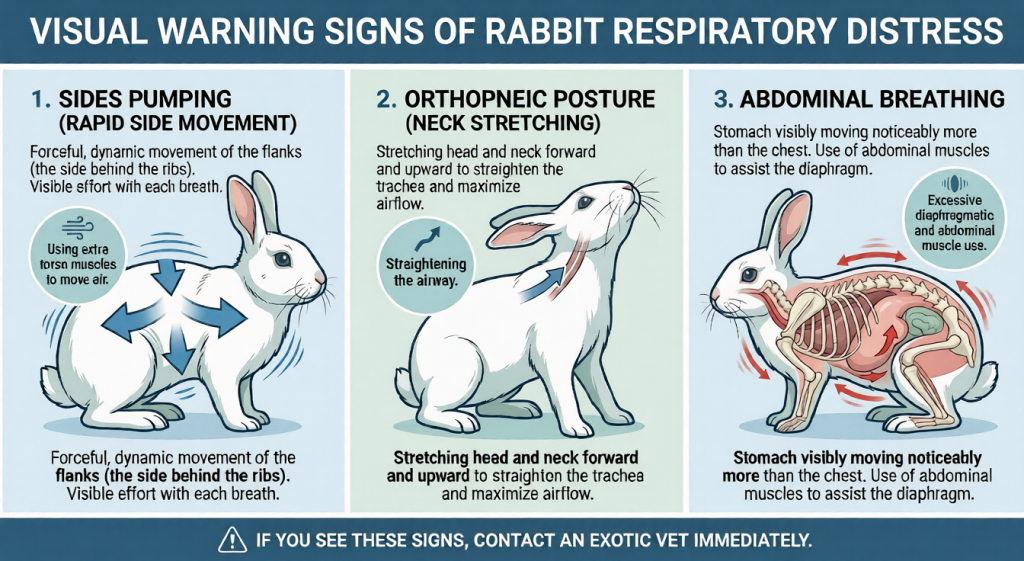
- Rapid Side Movement (“Sides Pumping”): In a distressed rabbit, the sides will pump in and out with great force. It looks as though the rabbit is using every muscle in its torso just to move air.
- Neck Stretching or Extended Posture: Known as “orthopneic posture,” the rabbit will sit with its front legs spread wide and its head and neck stretched out in a straight line. Detailed physiological descriptions of these postures can be found on Vetlexicon.
- Abdominal Breathing: If the stomach is moving more than the chest, the rabbit is likely using its abdominal muscles to assist the diaphragm. This is a classic sign of lower respiratory distress, often noted by the Rabbit Welfare Association & Fund (RWAF).
5. What to Do If Your Rabbit Is Breathing Fast or Heavy
The moments after you notice a breathing problem are critical. Your goal is to minimize further oxygen demand.
- Keep the Rabbit Calm and Quiet: Do not chase the rabbit. Increased movement requires more oxygen. Dim the lights and minimize noise.
- Move to a Cool, Well-Ventilated Area: If you suspect heatstroke, wipe the outside of their ears with a damp, room-temperature cloth. Blue Cross warns never to submerge a rabbit in cold water.
- Contact a Rabbit-Savvy Veterinarian: Ensure you have the number of an exotic specialist. You can find accredited professionals through the Association of Exotic Mammal Veterinarians (AEMV).
- Avoid Home Remedies: Oxygen therapy is often the only thing that can stabilize a rabbit in this state.
Table 3: Common Causes vs. Immediate Action
| Cause | Key Identification | Immediate Action |
| Heatstroke | Hot ears, damp fur, lethargy | Move to cool area, dampen ears, call vet. |
| Stress | Follows a specific scary event | Remove stressor, monitor for 15 minutes. |
| Pain/Bloat | Hunched posture, no appetite | Emergency vet visit—do not wait. |
| Respiratory Infection | Sneezing, white discharge | Schedule vet visit within 24 hours. |
| Heart Failure | Chronic fast breathing, blue gums | Emergency vet visit for oxygen. |
6. Can Rabbits Breathe Fast While Sleeping?
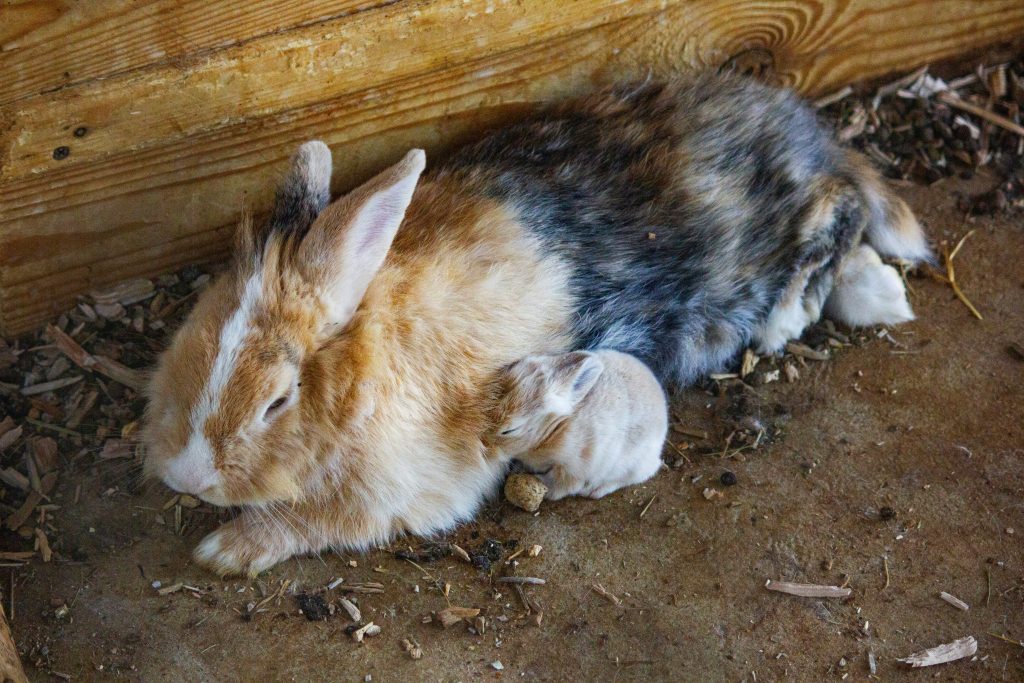
Yes, rabbits can breathe fast while sleeping, particularly during “REM” sleep. Much like dogs might twitch their paws, rabbits often “dream” about munching on clover or running from imaginary foxes.
In my observations with Mocha and Chino, I’ve seen brief spikes in breathing rate during deep sleep, accompanied by small mouth movements or whisker twitches. The difference is duration and context. A dreaming rabbit will typically settle back into a slow, rhythmic breath within a minute or two.
A dreaming rabbit looks relaxed—their body is usually flopped, not tensed or stretching their neck for air. If you are worried, a very gentle call of their name should “wake” them, and their breathing should normalize almost immediately. You can find more on differentiating these behaviors in my 2026 rabbit health guide.
7. Frequently Asked Questions (FAQ)
Why is my rabbit breathing fast but acting normal?
It could be simple excitement, curiosity, or a slightly warm environment. If the rabbit is eating, pooping, and playing, monitor the breathing for an hour.
Can rabbits have panic attacks?
While “panic attack” is a human term, rabbits experience acute panic that leads to hyperventilation. This must resolve quickly once the rabbit feels safe.
Why are my rabbit’s sides moving so fast?
This is often “pumping,” indicating the rabbit is using secondary muscles to breathe due to pain, heat, or lung issues.
Can GI stasis cause heavy breathing?
Yes. The pain from stasis and the pressure from gas (bloat) can both cause a rabbit to breathe rapidly.
Do rabbits breathe faster when hot?
Absolutely. Since they cannot sweat, they will breathe faster to try and move air, though it is not a very effective cooling method.
Why is my rabbit stretching its neck while breathing?
This is a sign of severe respiratory distress. They are trying to create the straightest possible path for air to enter their lungs.
Is wheezing dangerous in rabbits?
Yes. Any audible sound during breathing is abnormal and usually indicates a blockage or significant inflammation.
Can rabbits recover from respiratory distress?
With prompt veterinary care—including oxygen therapy and appropriate medications—many rabbits can recover, depending on the cause.
Can a lack of water intake cause fast breathing?
Yes, indirectly. Severe dehydration can lead to metabolic shock, kidney failure, or a condition where the rabbit is dangerously constipated and unable to poop, causing heavy breathing from acute internal distress.
8. Summary: When to Treat Fast Breathing as an Emergency
The takeaway for any rabbit owner is that visibility equals vulnerability. If you can clearly see your rabbit is “working” to breathe, they are in trouble. As a high-performance, low-reserve engine, a rabbit’s respiratory system fails with alarming speed, potentially triggering a sudden death health crisis. By mastering the nuances of their normal, silent rhythm, you become their first line of defense.
If your rabbit is gasping, stretching their neck, or breathing through their mouth, do not wait. Immediate veterinary care is the only way to ensure your bunny keeps hopping. Their silence is not a sign of health; it is a plea for you to be their voice.
Medical & Veterinary Disclaimer: Bunnyowners.com is an informational resource for rabbit owners and enthusiasts. We are not veterinarians. The content on this website is for educational purposes only and is not a substitute for professional veterinary advice, diagnosis, or treatment. Always consult a qualified veterinarian with any questions or concerns regarding your pet’s health, medical conditions, diet, or overall care. If you have concerns about your rabbit’s health, it’s always best to reach out to a veterinarian rather than relying solely on information found online.