
Written by Brent Hartman in FACTS
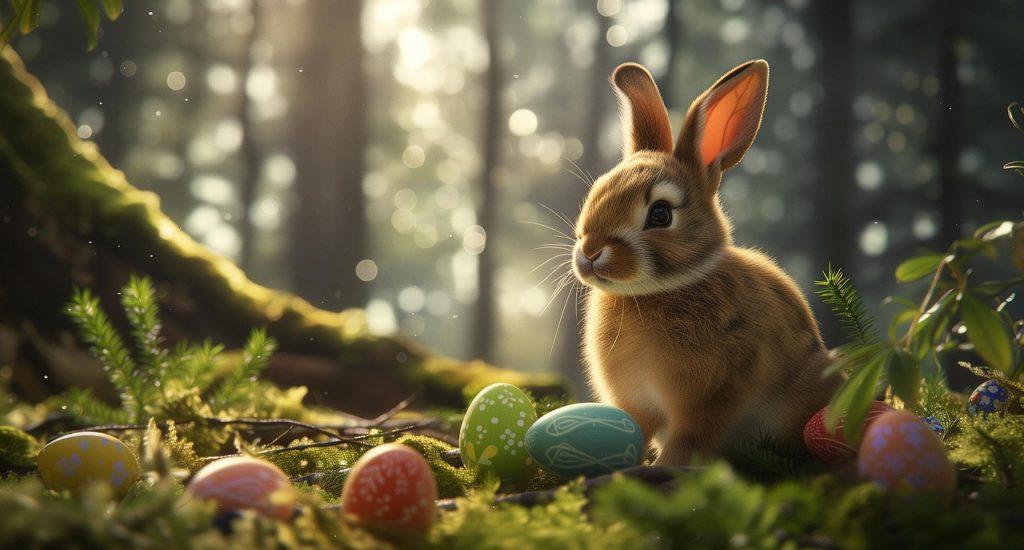
Do rabbits lay eggs? This question might sound a little crazy to some people, but this confusion makes a lot of sense to many, thanks to the Easter bunny and Easter eggs.
Rabbits do not lay eggs, contrary to popular myth. Rabbits are placental mammals and develop as embryos inside their mother’s uterus for an average of 31 days before birth. Since eggs are historical symbols of rebirth, the rabbit’s prodigious fertility is likely the basis for this egg-laying legend.
This is not the only “crazy” belief out there. in a survey conducted by The Innovation Center for U.S. Dairy, and heard on NPR, more than 1,000 adults were polled and discovered 48% of Americans aren’t sure where chocolate milk comes from and 7% thought chocolate milk only comes from brown cows.
I would say this is even crazier than the idea that rabbits come from eggs!!
But do not feel bad, this is a very common topic that receives its share of chatter on the internet. The main reason for the confusion behind rabbits laying eggs derives from the Christian holiday Easter and a bunny rabbit delivering Easter eggs to children around the world.
This article will look deeper into the origins of the Easter egg, and the Easter bunny, to fully understand this misconception. Additionally, we will explore some other mammals that actually do lay eggs and we’ll rake a deep dive into how rabbits give birth, so keep reading.
Origin Of Easter’s Rabbit Egg-laying Myth
To begin, we should take a look at the reason why rabbits laying eggs is such a common misconception, where it comes from, and its meaning.
The modern myth of rabbits laying eggs was likely the work of 18th-century German Lutheran immigrants who settled in Pennsylvania. These early immigrants brought with them their unique brand of Easter traditions when they formed the American Pennsylvanian Dutch Community.
These early Easter traditions were very similar to Christmas, Christmas Eve, and its protagonist, Santa Claus.
The night before Easter, children in the Dutch community would leave hats in a secret place as a “nest” for the Easter bunny, known as Oschter Haws (Easter Hare), hoping to be deemed as good girls and boys.
Boys would leave out caps and girls would leave bonnets, with the hopes that, while they slept, the Oschter Haws (Easter Hare), an egg-laying rabbit, would leave them treats.
Why the Rabbit and the Egg Got Combined
The exact moment these two symbols merged is lost to history, but it stems from overlapping meanings of rebirth. Here is a simplified breakdown:
Christian Adoption: The legend eventually merged into Christian traditions. While the pagan festival celebrated nature’s rebirth, Christian culture adopted the egg to symbolize the empty tomb after Jesus’s resurrection.
The Pagan Connection (Ēostre/Ostara): The earliest origin of the egg-laying rabbit may be linked to the ancient Festival of Ēostre (or Ostara), a feast honoring the Spring Equinox.
The Rabbit as Fertility Icon: The main focus of these ancient spring festivals was birth, new life, and fertility. Because they are among the most fertile animals on earth, rabbits were logical icons for this celebration.
The Egg as Symbol of Rebirth: The egg was historically seen as a promise of new life.
But the decorated and colorful eggs are not something recent, they could even be older than the egg-laying rabbit.
According to historical records, decorated eggs samples have been found at some ruins in Egypt, Greece, Persia, and Rome, dating back to the year 3000 BC. Many Ancient civilizations used decorated eggs in spring celebrations.
Today, this Easter tradition has evolved, and most of the eggs are not actual eggs but eggs made of chocolate, sometimes also containing other treats inside. Additionally, the way kids collect eggs has changed over time resulting in egg hunts and other games allowing children to win the eggs.
This ancient confusion is actively reinforced today by modern media and marketing. Iconic figures like Bugs Bunny and the clucking, egg-laying Cadbury Easter Bunny continue to conflate poultry and lagomorphs in popular culture. This constant, lighthearted mixing ensures that “Do rabbits lay eggs?” remains a common, albeit biologically incorrect, question for every new generation of children.
If Not By Egg, How Do Rabbits Give Birth?
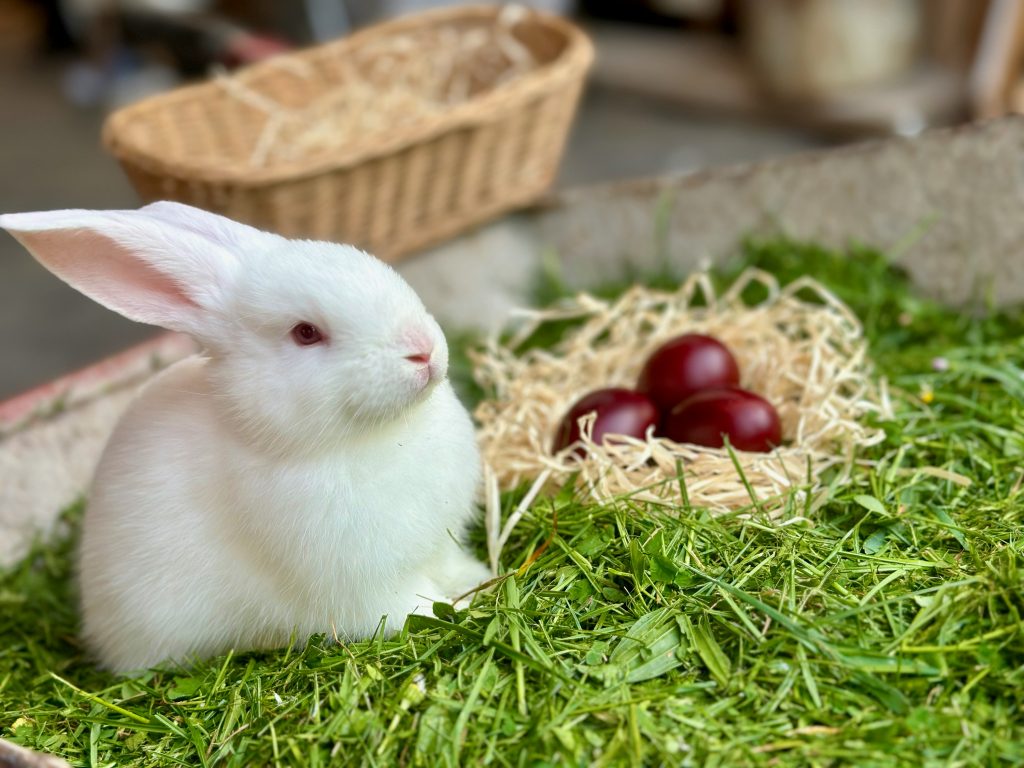
To fully understand how rabbits deliver their baby bunnies, we have to look past the holiday myths and focus on real Rabbit Facts. One must know when female and male rabbits are fertile, pregnant, and the actual process of labor.
Why Real-World Confusion Persists: The Cecal Pellet Phenomenon
While the Easter legend dominates cultural confusion, there is a practical, physical reason a new rabbit owner might mistakenly think their pet laid an egg. Rabbits are designed to digest complex plant fibers by producing two distinct types of droppings. One type, called cecotropes (or “night feces”), are clustered, soft, slightly glossy, and often dark in color. If a child finds a cluster of cecotropes in the hutch, they can easily mistake the appearance for a grouping of very small, dark, soft-shelled eggs. Addressing this unique biological trait directly helps deconstruct the visual myth.
The Reproductive Blueprint: What Defines a Mammal?
Beyond physical mix-ups, the definitive answer lies in rabbits’ biological classification. Rabbits possess fur, are warm-blooded, and develop internally as placental mammals. Critically, as mammals, they are defined by the presence of mammary glands, which they use to feed their live-born young after birth. Their entire anatomy contradicts the external, shelled reproductive method required to “lay eggs.”
Female rabbits become fertile and can become pregnant as soon as they turn 12 weeks old, and remains so until 4 years old for females. As for males, They are able to sire offspring up until 7 years of age. In addition, female rabbits can become pregnant at any time of the year.
Once the female rabbit, or doe, becomes pregnant, there are a few behaviors that can let you know baby bunnies are on the way.
The behaviors that tell you your rabbit is pregnant include:
- The doe will build a nest where she will deliver and house their babies.
- Rabbits begin to pull their fur out to create a blanket to keep the baby bunnies warm.
- Female rabbits will become more aggressive and ofrten growl in defense of the nest.
While your rabbit is pregnant, she will need to drink ample clean water and eat healthy food including leafy greens, alfalfa hay, and rabbit pellets.
Be sure to provide a relaxed and private place such as a nesting box to keep the doe and her offspring comfortable.
The pregnancy in rabbits lasts around 31 days. The act of giving birth takes about 15 minutes and is called kindling, in which the mother can deliver 12 or more babies. Kindling tends to occur in the first hours of the day, and most rabbits will not need human assistance as it is an instinctive process.
Once the female rabbit, or doe, has ensured the babies are alive and healthy, you should try to leave the kits alone for the first few days to avoid the mother feeling stressed out, which can cause her to stop feeding her babies.
Baby bunnies, called kits, are hairless, blind, and deaf; and it takes ten days for them to start developing properly. The Kits get nursed twice a day and nursing lasts around 5 minutes as the mother’s milk is extremely rich.
To be fully weaned from their mothers, kits need to be around 4 to 6 weeks of age. During all this time, the mother should remain separated from the male rabbit, as she can become pregnant just hours after giving birth.
Do Any Mammals Lay Eggs?
Although rabbits do not lay eggs, this does not rule out the possibility of other mammals doing so. There are just two mammals that can lay eggs in the world, and these belong to the unique third group of animals called Monotreme mammals.
Mammals that lay eggs include:
- The echidna, also known as the spiny anteater. This one lays the eggs in a pouch where they will hatch.
- The platypus. These lay the eggs in an underground nest.
In some ways, monotremes are more similar to reptiles than mammals.
Besides laying eggs, a monotreme’s average body temperature of about 31 °C (88 °F) is considerably lower than most other mammals. In fact, with marsupials raging 35 °C (95 °F) and 37 °C (99 °F) for placental mammals, a monotremes body temperature most resembles that of reptiles than other mammals.
Frequently Asked Questions (FAQ): The History and Science of Rabbits at Easter
Where does the story of the Easter Bunny delivering eggs come from?
The legend of a hare delivering eggs likely originated with 18th-century German Lutheran immigrants who settled in Pennsylvania. They introduced the tradition of the “Oschter Haws” (Easter Hare), a fictional character similar to Santa Claus, who would leave colored eggs and treats in hats or “nests” for good children the night before Easter.
Why are rabbits and eggs both used as symbols for Spring celebrations?
Ancient civilizations and history festivals celebrating the Spring Equinox often focused on rebirth and fertility. Because they breed so prodigiously, rabbits became a logical icon of fertility. Eggs were historically viewed as a promise of rebirth. The myth of an egg-laying rabbit effectively combined these two potent symbols into one legend.
As mammals, how do rabbits actually reproduce?
Rabbits are placental mammals, meaning they develop as embryos inside the mother’s uterus for an average of 31 days. They give birth to live, developed young through a process called “kindling,” which usually takes about 15 minutes.
How many babies can a rabbit have, and how fast can they multiply?
Rabbits are exceptionally fertile. A female rabbit (doe) can become pregnant at 12 weeks old and can breed at any time of the year. During kindling, a doe can deliver 12 or more babies, called kits. Furthermore, a doe can become pregnant again just hours after giving birth.
What are baby rabbits like when they are first born?
At birth, baby rabbits (kits) are hairless, blind, and deaf. Because the mother’s milk is extremely rich, kits only need to nurse about twice a day for approximately 5 minutes. They typically begin developing properly after ten days and are weaned between 4 to 6 weeks of age.
Are there any known mammals that actually lay eggs?
Yes, but they are a very rare and unique group belonging to a classification called Monotreme mammals. There are only two types of egg-laying mammals in the world: the Platypus and the Echidna (also known as the spiny anteater). These unique mammals have lower body temperatures than other mammals and share some characteristics with reptiles.
Final Words
To wrap this up in just a few words, we can say rabbits do not lay eggs. Still, the rabbit and the egg have something in common. They both symbolize new life and fertility, which was why they were used in ancient festivals across the world celebrating the beginning of spring, a new life, and fertility.
Rabbits symbolize fertility thanks to their prodigious breeding. Female rabbits can become pregnant at the age of 12 weeks, and until they are 4 years old, they can get pregnant any time of the year. Pregnancy in rabbits lasts about 31 days when they give birth to approximately 12 kits. After a few hours of giving birth, female rabbits can become pregnant again.
So, now you know, if you are considering a rabbit as a pet but do not want to end up with a vast family tree, try to keep females and males separate from each other.